
Education
Can People With Asthma Take Peptides?
Published Sep 13, 2026
Can people with asthma safely use peptides? Learn what current research says about peptides, asthma, respiratory health, and the risks of using unapproved peptide products.
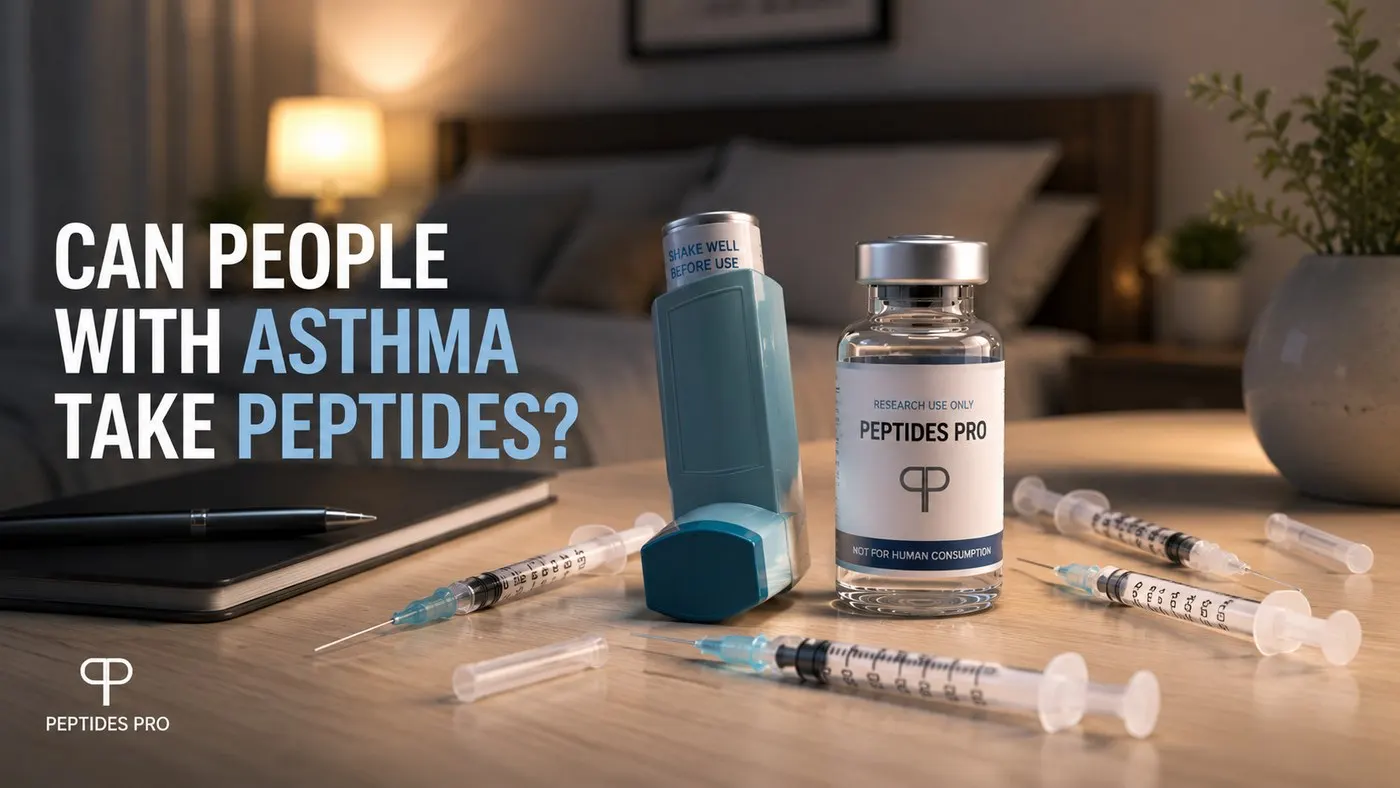
If you have asthma and are interested in peptides, one of the most important questions to ask is not simply, "Can I take peptides?"
The better question is: Which peptide, for what purpose, and what is actually known about its safety in someone with asthma?
Asthma is a chronic respiratory condition involving inflammation and narrowing of the airways. Because peptides can affect different biological pathways throughout the body, it is not accurate to assume that every peptide will have the same effect on someone with asthma.
Some peptides are being investigated in areas related to inflammation, metabolism, tissue repair, and respiratory biology. Others are marketed online as "research peptides" without established clinical indications or adequate human safety data.
That distinction matters.
For someone living with asthma, the main issue is not that having asthma automatically makes peptides unsafe. The bigger issue is whether the specific peptide has been properly studied, approved for human use, and evaluated for the person's particular health situation.
What Exactly Are Peptides?
Peptides are short chains of amino acids. They occur naturally in the human body and can act as signaling molecules involved in processes such as hormones, metabolism, immune responses, and tissue regulation.
Because peptides can influence biological pathways, researchers have explored them for many different applications.
However, "peptide" is a very broad category.
A peptide used in an approved medicine is very different from an experimental compound sold online as a research peptide.
This is especially important for people with chronic conditions such as asthma.
A product being described as a peptide does not automatically mean it has been proven safe, effective, or appropriate for people with respiratory disease.
Does Having Asthma Mean You Cannot Use Peptides?
Not necessarily.
Asthma itself is not a universal contraindication to every peptide or peptide-related medicine.
The answer depends heavily on the specific compound, its approved purpose, how it affects the body, and the person's overall health.
Some peptide-based or peptide-related treatments are being investigated for conditions that involve inflammation or metabolism. At the same time, researchers have also studied naturally occurring peptides and peptide signaling pathways in the lungs.
This does not mean that experimental peptides should be used to treat asthma.
It simply shows why the word "peptide" by itself is not enough to determine whether something is safe for a person with asthma.
A person with well-controlled asthma may have a very different risk profile from someone experiencing frequent asthma attacks, severe uncontrolled asthma, or other respiratory complications.
What Does Asthma Have to Do With Peptides?
The relationship between peptides and asthma is actually an interesting area of scientific research.
The lungs contain numerous signaling molecules, including regulatory peptides and neuropeptides. Researchers have investigated how these molecules interact with airway inflammation, immune responses, and airway constriction.
Some peptide pathways appear to contribute to inflammatory processes, while others have been investigated for potentially protective effects.
This has led scientists to investigate whether certain peptide pathways could eventually become therapeutic targets for respiratory diseases.
But there is an important difference between studying a biological pathway and having a proven peptide treatment for asthma.
Research into a peptide does not automatically mean the peptide is ready for routine human use.
Are Peptides Used to Treat Asthma?
There are peptide-related research areas connected to asthma, but that should not be confused with established peptide treatment for the condition.
Modern asthma treatment is based on therapies with substantially stronger clinical evidence. Current international asthma guidance emphasizes inhaled corticosteroid-containing treatment as a foundation of asthma management, with additional therapies used according to the severity and characteristics of the disease.
For some people with severe asthma, doctors may also consider biologic medicines that target specific inflammatory pathways.
These include treatments directed at targets such as IgE, interleukin-5 pathways, interleukin-4 receptor alpha, and thymic stromal lymphopoietin.
Importantly, many of these biologic medicines are monoclonal antibodies, not peptides.
This distinction is often lost in online discussions where almost every injectable biological treatment gets grouped together under the word "peptides."
What About BPC-157 and Asthma?
BPC-157 is frequently discussed online in relation to tissue repair, inflammation, and recovery.
It is also one of the compounds that demonstrates why people with asthma should be cautious about assuming that a popular research peptide is automatically safe.
BPC-157 is not an established treatment for asthma, and there is not enough high-quality human evidence to determine that it is safe or effective for treating asthma.
The U.S. Food and Drug Administration has also highlighted significant uncertainties surrounding compounded BPC-157, including limited safety information and concerns involving peptide-related impurities and immunogenicity.
That does not prove that BPC-157 will cause an asthma attack.
It means there is not enough reliable evidence to confidently predict its safety in people, including people with respiratory conditions.
What About TB-500 and Other Research Peptides?
Similar questions apply to other compounds commonly marketed in the research-peptide space.
TB-500, various growth-hormone-related peptides, and other experimental compounds may have interesting mechanisms or laboratory findings behind them.
But laboratory evidence is not the same thing as established clinical evidence.
For someone with asthma, the absence of good human safety data becomes particularly important because the respiratory system is already affected by the underlying condition.
An experimental compound may interact with immune, inflammatory, cardiovascular, or metabolic pathways in ways that are not fully understood.
That uncertainty should not be ignored simply because a product is marketed as "natural," "healing," or "research only."
Could Some Peptides Potentially Affect Asthma?
Possibly.
Researchers have investigated several peptide pathways that appear to influence airway inflammation and airway responsiveness.
For example, vasoactive intestinal peptide and other regulatory peptides have been studied because of their activity within the respiratory system.
There has also been research into angiotensin-(1-7), a naturally occurring peptide that has shown potentially interesting effects in experimental models of airway inflammation.
However, promising laboratory findings are not enough to establish a peptide as an asthma treatment.
For some of these compounds, disease-specific clinical trials in asthma are still lacking.
This is an important distinction for anyone researching peptides online:
Potential mechanism does not equal proven treatment.
What If Someone With Asthma Wants to Use Peptides for Another Reason?
This is where the conversation becomes more complicated.
Someone may have asthma but be interested in a peptide for an unrelated reason, such as body composition, recovery, skin, or another wellness goal.
In that situation, the question is not necessarily whether the peptide treats asthma.
The question is whether the peptide could interact with the person's existing condition, medications, allergies, or other health risks.
A person using asthma medication should not assume that a peptide is automatically compatible with those medications simply because the peptide is being used for a different purpose.
This is particularly relevant with experimental products, where human interaction data may be limited or unavailable.
What About Peptides in Bali?
Bali has become a major destination for wellness, aesthetics, fitness, and longevity services.
That has also contributed to greater interest in peptide-related products and treatments.
But the availability of a peptide through a clinic, wellness center, online seller, or social media account does not by itself establish that the product is appropriate for someone with asthma.
Indonesia's pharmaceutical regulator, BPOM, regulates medicines and their handling, including requirements concerning authorized medicines and clinical research.
For products that are still investigational, clinical research is subject to regulatory requirements rather than simply being treated as ordinary wellness products.
This is particularly important for visitors in Bali who may see peptides advertised as part of a wellness package.
The question should not simply be:
"Does this clinic offer peptides?"
It should be:
"What exactly is the product, what is its regulatory status, what is it being used for, and what evidence supports its use in someone with asthma?"
Should Someone With Asthma Tell a Clinic About Their Condition?
Yes.
Any healthcare professional assessing someone for a peptide or other injectable treatment should know about relevant medical conditions, including asthma.
They should also know about relevant medications, allergies, previous reactions to medicines, and other important health information.
This matters because asthma is not one uniform condition.
People can have different asthma triggers, levels of severity, patterns of exacerbations, and associated allergic or inflammatory conditions.
A responsible clinical assessment should consider the individual rather than treating "asthma" as a simple yes-or-no checkbox.
What Are the Biggest Red Flags?
One major warning sign is a clinic or seller claiming that a peptide is completely safe simply because it is a peptide.
Another is a claim that an experimental peptide can replace established asthma treatment.
Statements such as "this peptide cures asthma," "you won't need your inhaler anymore," or "there are no side effects" should be treated with extreme skepticism.
Other warning signs include products with unclear ingredients, unclear manufacturing standards, no reliable product information, or claims based mainly on testimonials rather than human clinical evidence.
A professional-looking website does not necessarily mean the underlying product has been clinically validated.
The Bottom Line
So, can people with asthma take peptides?
There is no single yes-or-no answer because peptides are an extremely broad category.
Having asthma does not automatically mean that every peptide is forbidden. However, that also does not mean that experimental peptides are automatically safe for people with asthma.
The specific peptide matters.
The evidence matters.
The person's asthma severity, medications, allergies, and overall health matter.
Most importantly, research peptides should not be treated as established asthma treatments simply because they are discussed in scientific studies or offered by wellness businesses.
For people with asthma who are considering a peptide for another purpose, the safest approach is to evaluate the specific compound rather than making assumptions based on the word "peptide."
Asthma is a condition where established medical treatment has an important role, and experimental products should not be used as a substitute for proven asthma care.
Frequently Asked Questions
Can I use peptides if my asthma is controlled?
Controlled asthma does not automatically make every peptide safe. The specific compound, its regulatory status, available human evidence, and your individual health situation still matter.
Can peptides make asthma worse?
There is not enough evidence to say that peptides as a category make asthma worse. Different peptides have different biological effects, and some experimental compounds have not been adequately studied in people with asthma.
Is BPC-157 a treatment for asthma?
No. BPC-157 is not an established asthma treatment, and there is insufficient high-quality human evidence to establish it as safe or effective for treating asthma.
Can peptides replace an asthma inhaler?
Peptides should not be assumed to replace established asthma medication. Current asthma guidelines continue to emphasize evidence-based inhaled treatments as a central part of asthma management.
Are asthma biologics the same as peptides?
Not usually. Several biologic medicines used for severe asthma are monoclonal antibodies rather than peptides. They work by targeting specific immune pathways and are prescribed according to established clinical criteria.
Should I tell a clinic that I have asthma before using a peptide?
Yes. A healthcare professional should know about relevant medical conditions and medications before evaluating an experimental or prescription treatment.
Are peptides offered in Bali automatically safe because they are provided by a clinic?
No. A clinic's availability of a product does not by itself establish its safety, effectiveness, or regulatory status. The specific product and its clinical and regulatory evidence should be evaluated.
Conclusion
The growing interest in peptides has created plenty of excitement around what these compounds might eventually do.
For people with asthma, however, excitement should not replace evidence.
Some peptide pathways are genuinely being investigated in respiratory research, and future therapies may emerge from this work. But promising laboratory research is very different from a proven clinical treatment.
If you have asthma and are considering a peptide, focus less on the word "peptide" and more on the individual compound, its evidence, its regulatory status, and whether it has actually been studied in people with your health profile.
When it comes to respiratory health, uncertainty is something worth taking seriously.
Medical Disclaimer: This article is for educational and informational purposes only. It is not medical advice and does not diagnose, treat, cure, or prevent asthma or any other medical condition. Peptides vary significantly in their pharmacology, evidence, regulatory status, and safety. Research peptides may not be approved for human use and may carry unknown risks. Anyone with asthma or another medical condition should discuss the specific product with a qualified healthcare professional before considering its use. Established asthma medications should not be stopped or replaced based on information from this article.