
Education
Can You Take Peptides During Pregnancy? Which Peptides Are Safe and Which to Avoid
Published Aug 25, 2026
Can you take peptides during pregnancy? Learn which peptide medications may be used under medical supervision, which popular research and wellness peptides should be avoided, and why pregnancy changes the safety equation.
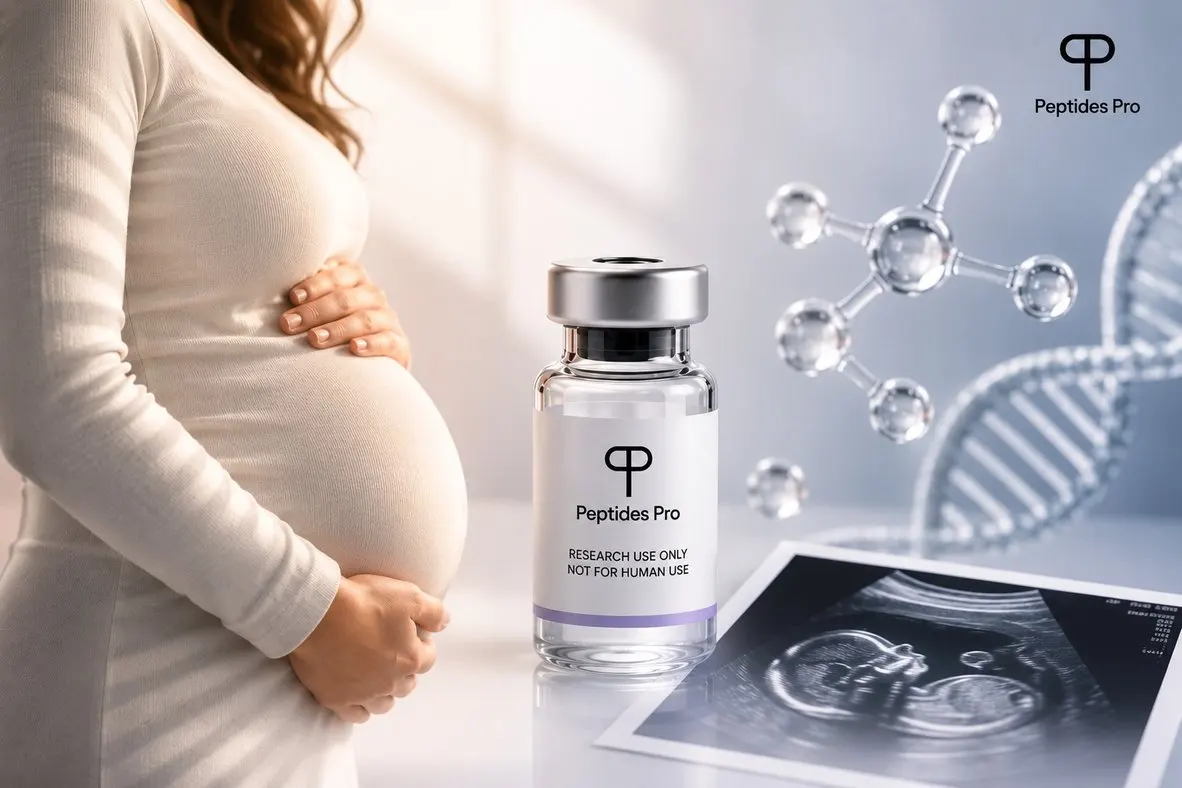
Pregnancy changes the answer to almost every question about medication, supplements, hormones, and peptides.
A peptide that may be investigated for weight management, recovery, muscle growth, skin health, or longevity outside pregnancy cannot automatically be considered safe once someone becomes pregnant. The developing fetus introduces an entirely different safety standard, and for many newer peptides, there simply is not enough human pregnancy research to establish that they are safe.
This is especially important because the word "peptide" describes a huge family of molecules. Some peptides are naturally occurring hormones or established medicines that doctors have used during pregnancy for decades. Others are experimental compounds with little or no human pregnancy data.
So the real question is not simply:
"Are peptides safe during pregnancy?"
The better question is:
"Which peptide is it, what is it being used for, and what evidence exists about pregnancy exposure?"
The Short Answer
If you are pregnant, do not start a peptide for weight loss, anti-aging, muscle growth, recovery, tanning, longevity, or general wellness without speaking with your obstetrician or another qualified healthcare professional.
Many popular peptides used in the wellness and research market should be avoided during pregnancy because they have not been adequately studied in pregnant humans.
Some peptide-based medicines are different. Certain established peptide hormones, such as insulin, are routinely used when medically indicated during pregnancy. Other peptide medicines, such as desmopressin, may also be used for specific medical conditions when the benefits outweigh the risks.
The important distinction is that these are medical treatments prescribed for a specific condition, not general-purpose wellness peptides.
Why Pregnancy Changes the Peptide Safety Question
Pregnancy is not simply a situation where the mother takes a compound and the fetus remains completely separate from it.
Some drugs can cross the placenta. Others can influence hormones, metabolism, blood glucose, appetite, blood pressure, uterine activity, or other systems that are important during pregnancy.
There is also another problem: many modern peptides have never been adequately tested in pregnant humans.
That means researchers may not know whether a particular compound affects:
- fetal development
- miscarriage risk
- fetal growth
- placental function
- preterm birth
- maternal health
- newborn health
- long-term development
Lack of evidence is therefore not the same thing as evidence of safety.
The American College of Obstetricians and Gynecologists recommends reviewing prescription medicines, nonprescription medicines, supplements, and herbal products before and during pregnancy because pregnancy can change the safety profile of substances that would otherwise seem harmless.
Peptides You Should Generally Avoid During Pregnancy
The biggest category to avoid is experimental or research peptides that do not have established pregnancy safety data.
This includes many compounds promoted online for recovery, longevity, body composition, muscle growth, or anti-aging.
BPC-157
BPC-157 is an experimental peptide frequently discussed for tissue repair, gastrointestinal health, and recovery.
It has not been established as a pregnancy-safe medicine.
There is not enough high-quality human pregnancy data to determine whether BPC-157 is safe for a developing fetus.
For that reason, pregnancy is not an appropriate time to experiment with BPC-157.
TB-500
TB-500 is another experimental peptide associated with tissue repair and recovery.
Despite its popularity in peptide communities, it does not have the type of established human pregnancy safety evidence required to recommend its use during pregnancy.
It should therefore be avoided unless a qualified physician specifically determines otherwise in a legitimate medical context.
CJC-1295
CJC-1295 is a growth-hormone-releasing peptide used experimentally for body composition, recovery, and other purposes.
There is insufficient human pregnancy evidence to establish its safety.
Changing growth-hormone signaling during pregnancy is not something that should be approached as a general wellness experiment.
Ipamorelin
Ipamorelin is another growth-hormone secretagogue frequently marketed in peptide and bodybuilding communities.
There is not enough evidence to establish its safety during pregnancy.
It should not be treated as a pregnancy-safe supplement simply because it is a peptide rather than a conventional pharmaceutical.
Sermorelin
Sermorelin is a synthetic peptide that stimulates the release of growth hormone.
Although it has medical history outside pregnancy, that does not mean it should be used during pregnancy for anti-aging, recovery, muscle growth, or wellness purposes.
Pregnancy-specific safety must be considered separately.
Tesamorelin
Tesamorelin is a growth-hormone-releasing hormone analogue used medically for a specific indication in adults.
It is not a pregnancy wellness treatment, and there is insufficient evidence to establish its safety for use during pregnancy.
It should not be used simply for body composition or anti-aging purposes while pregnant.
GHK-Cu
GHK-Cu is a copper-binding peptide widely used in skincare and discussed in regenerative and anti-aging research.
Topical cosmetic products containing peptide ingredients are a different issue from injectable or systemic peptide products.
However, injectable GHK-Cu and other experimental systemic forms should not be assumed to be safe during pregnancy simply because GHK-Cu is also found in cosmetic products.
When pregnancy is involved, the route of administration and the exact formulation matter.
PT-141
PT-141, also known as bremelanotide, is a melanocortin receptor agonist.
Although bremelanotide is an approved prescription medicine for a specific indication in certain women, it is not a treatment for pregnancy and should not be used during pregnancy unless specifically directed by a physician.
Melanotan
Melanotan peptides are frequently marketed for tanning and cosmetic purposes.
They are not established pregnancy-safe medicines.
Pregnancy is not an appropriate time to use experimental tanning peptides.
AOD-9604 and Other Weight-Loss Peptides
Experimental peptides marketed for fat loss or metabolism should also be avoided during pregnancy.
Pregnancy is not a period for intentional pharmacological weight loss. The goal is appropriate maternal nutrition and healthy fetal development, not aggressive fat-loss protocols.
What About Semaglutide and Tirzepatide?
This is one of the most important questions because GLP-1 medications are now extremely popular.
Semaglutide
Semaglutide is a GLP-1 receptor agonist used in medicines such as Ozempic, Wegovy, and Rybelsus.
It is not recommended for weight loss during pregnancy.
The product labeling recommends discontinuing semaglutide before a planned pregnancy because the drug can remain in the body for an extended period.
Human pregnancy data are still limited. Available observational data have not established an increased risk of birth defects from early GLP-1 exposure, but this does not mean semaglutide has been proven safe during pregnancy.
There is an important difference between:
"No safety signal has been demonstrated in limited data"
and
"This medication is safe to take during pregnancy."
Those statements are not equivalent.
Tirzepatide
Tirzepatide is another popular medication used for diabetes and weight management.
It is also not recommended for weight loss during pregnancy.
Human studies have not established whether tirzepatide increases the risk of miscarriage or birth defects. Animal studies have raised concerns, including reduced fetal or offspring weight and developmental findings, although it can be difficult to separate drug effects from effects related to maternal weight loss or other factors.
If someone becomes pregnant while taking tirzepatide, they should contact their healthcare provider rather than trying to manage the situation independently.
Are Any Peptides Actually Used During Pregnancy?
Yes.
This is where the conversation becomes more nuanced.
Some important medicines are peptides or peptide-based hormones, and certain ones have established medical uses during pregnancy.
Insulin
Insulin is a peptide hormone and is one of the clearest examples.
Insulin is routinely used during pregnancy when medically indicated, particularly when diabetes or gestational diabetes requires medication.
ACOG describes insulin as a preferred treatment for gestational diabetes when lifestyle measures are not enough. It has a long history of use in pregnancy and does not cross the placenta in clinically significant amounts.
But this does not mean that all peptides are safe.
Insulin is a specific, well-characterized medical treatment with extensive pregnancy experience.
That is very different from taking an experimental peptide purchased online.
Desmopressin
Desmopressin is a synthetic analogue of the natural hormone vasopressin.
It is used for certain medical conditions, including central diabetes insipidus.
Available pregnancy experience has not identified an increased risk of major birth defects, miscarriage, or other major adverse maternal or fetal outcomes associated with desmopressin.
However, it is still a prescription medicine used for specific medical indications.
It is not something to take as a general wellness peptide.
Oxytocin
Oxytocin is a peptide hormone naturally produced by the body.
Synthetic oxytocin is used medically to induce or strengthen labor and to manage certain situations after delivery.
This is another example of why saying "peptides are unsafe during pregnancy" would be misleading.
Oxytocin can be extremely useful in obstetric medicine, but it must be administered in an appropriate clinical setting because excessive uterine stimulation can create serious risks for both mother and baby.
The lesson is simple:
A peptide can be appropriate during pregnancy when there is a specific medical indication, established evidence, and professional supervision.
What About Collagen Peptides?
Collagen peptides are different from injectable research peptides.
Collagen peptides are dietary protein fragments commonly sold as nutritional supplements.
They are not the same category as injectable compounds such as BPC-157, CJC-1295, or semaglutide.
However, "natural" does not automatically mean "pregnancy-safe."
If you are pregnant and considering a collagen supplement, discuss the specific product with your healthcare professional. The complete ingredient list matters because supplements can contain additional herbs, vitamins, stimulants, or other compounds beyond collagen.
The safest approach is to evaluate the entire product rather than focusing only on the word "peptide."
Why You Should Not Experiment With Peptides During Pregnancy
Pregnancy is one of the worst times to rely on anecdotal peptide reports.
Online communities may contain hundreds of people saying that a particular peptide "worked perfectly" for them.
That does not establish pregnancy safety.
Clinical research requires much more than individual experiences. Researchers need to understand how a compound behaves in pregnancy, whether it crosses the placenta, how pregnancy changes its metabolism, and whether exposure affects fetal development.
For newer peptides, those answers may simply not exist yet.
This is particularly important with compounds that influence:
- growth hormone
- insulin sensitivity
- appetite
- glucose metabolism
- reproductive hormones
- melanocortin signaling
- immune pathways
- tissue growth
- vascular biology
A compound can have an interesting biological mechanism and still be completely inappropriate to use during pregnancy.
What If You Were Taking a Peptide Before You Realized You Were Pregnant?
This is a very different situation from deliberately starting a peptide during pregnancy.
If you discover that you are pregnant after taking a peptide, do not panic and do not assume that exposure automatically means something is wrong with the pregnancy.
Some people are exposed to medications before they know they are pregnant.
The correct response is to tell your healthcare provider exactly what you took.
Bring:
- the exact peptide name
- the product label
- the manufacturer or supplier
- the formulation
- the dates you used it
- the approximate amount taken
- the date of your last dose
Your doctor can then determine whether additional monitoring or specialist advice is appropriate.
ACOG specifically recommends discussing medications and supplements with an obstetric care provider as soon as pregnancy is suspected or confirmed.
The Difference Between "Not Recommended" and "Known to Be Dangerous"
This distinction matters.
There are three broad categories:
Known or established pregnancy-compatible medicines: These have substantial clinical experience and are used when medically indicated, such as insulin.
Medications that are not recommended during pregnancy: These may have animal findings, limited human data, potential risks, or no benefit that justifies exposure. Semaglutide and tirzepatide fall into this category for pregnancy and weight management.
Experimental peptides with insufficient pregnancy data: These include many popular research peptides such as BPC-157, TB-500, CJC-1295, ipamorelin, and similar compounds.
The third category should not be interpreted as "probably safe."
It means researchers do not have enough evidence to confidently tell you that exposure is safe.
A Simple Pregnancy Peptide Checklist
Before taking any peptide during pregnancy, ask:
Is this an approved medicine?
What exactly is the active ingredient?
Is there human pregnancy data?
Does the official prescribing information address pregnancy?
What is the medical reason for taking it?
Is there a safer, established alternative?
Has my obstetrician approved it?
If the answer to several of these questions is unknown, that is a strong reason to stop and get professional advice before using the product.
The Bottom Line
There is no universal rule that says every peptide is unsafe during pregnancy.
Peptides include everything from naturally occurring hormones and established medicines to experimental compounds that have barely been studied in humans.
Some peptide medicines, such as insulin, have an established role in pregnancy when medically indicated. Desmopressin may also be used for specific conditions under medical supervision, while oxytocin has an established role in labor and postpartum care.
That does not make experimental wellness peptides safe.
Popular compounds such as BPC-157, TB-500, CJC-1295, ipamorelin, sermorelin, tesamorelin, melanotan, and other research peptides should not be treated as pregnancy-safe treatments simply because they are widely discussed online.
And popular GLP-1 medicines such as semaglutide and tirzepatide are not recommended for weight loss during pregnancy.
Pregnancy is not the time to experiment with an uncertain compound. When a peptide is medically necessary, the decision should be based on the specific drug, the condition being treated, the available pregnancy evidence, and the judgment of a qualified healthcare professional.
This article is for educational and informational purposes only. It does not constitute medical advice, diagnosis, or treatment. Pregnancy changes the safety profile of many medications and supplements. Do not start, stop, or change a medication or peptide during pregnancy without discussing it with a qualified healthcare professional.