
Skin Health
GHK-Cu and Skin Aging: What People Mean by 'Copper Peptides'
Published Jul 3, 2026
GHK-Cu is one of the most studied peptides in skincare and aging research. Here's a clear explanation of what it is, what the evidence suggests, and where the claims outrun the science.
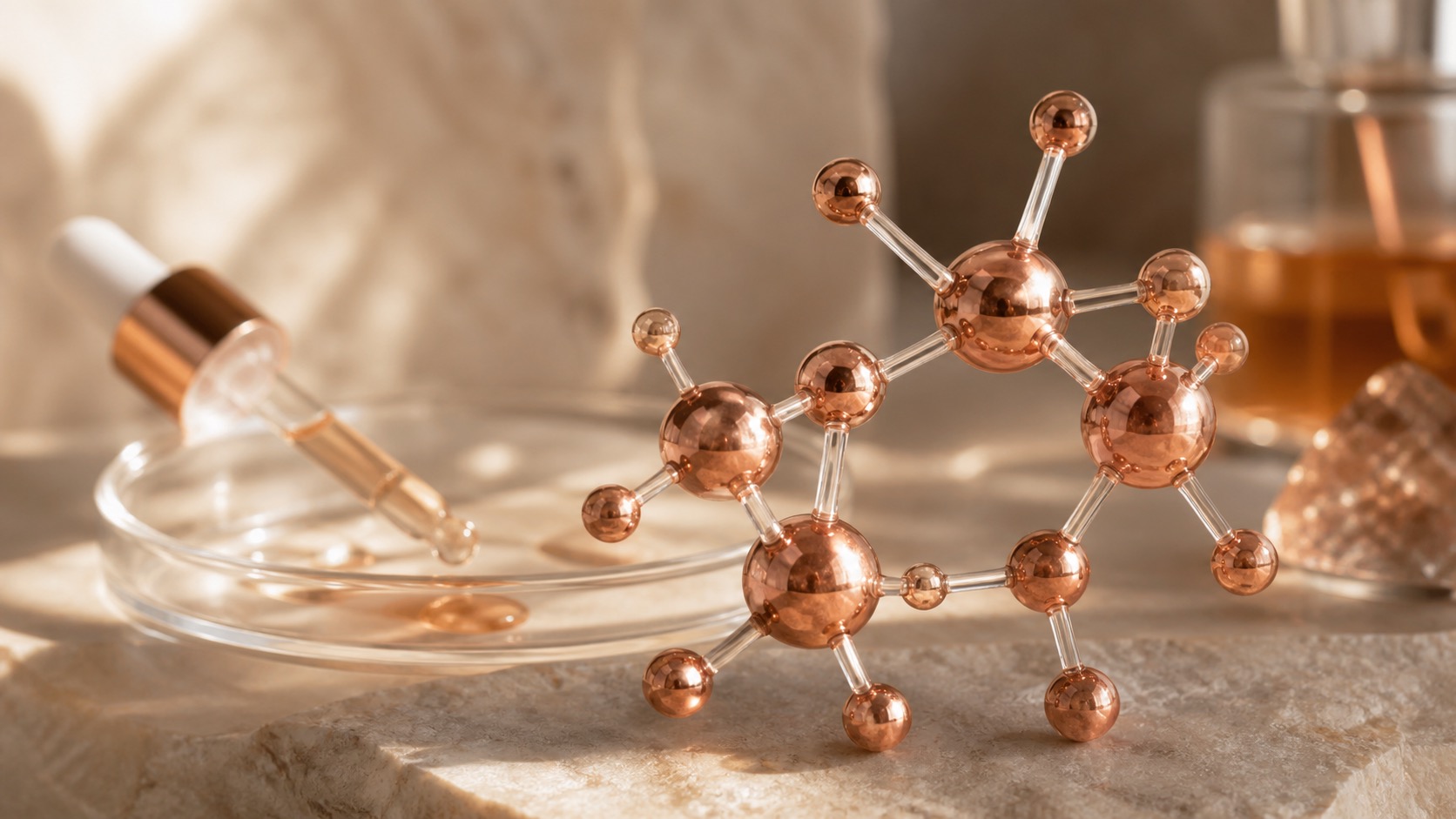
The term "copper peptides" has migrated from research literature into mainstream skincare vocabulary over the last decade. It appears on serums, in dermatology discussions, on longevity podcasts, and in aesthetic medicine conversations about injectable treatments for skin rejuvenation. As with many peptide compounds, the range of claims — from modest cosmetic benefit to sweeping anti-aging effects — spans a wide spectrum of what the evidence actually supports.
GHK-Cu, or glycyl-L-histidyl-L-lysine copper complex, is the specific compound most people mean when they say "copper peptides." It is one of the more extensively studied naturally occurring peptides in the context of skin biology and aging — which is why it is worth understanding clearly.
Key Takeaways
- GHK-Cu is a naturally occurring copper complex found in human plasma, urine, and saliva. Its levels decline with age, which has driven interest in its potential role in aging.
- It has been studied for roles in wound healing, collagen synthesis, skin remodeling, and anti-inflammatory effects — with a reasonably developed body of research compared to many biohacking peptides.
- Evidence for topical GHK-Cu in skin health is more developed than for many cosmetic ingredients. Evidence for systemic or injectable use specifically for skin aging is less standardized.
- Claims about GHK-Cu "reversing aging" or "regrowing hair" significantly outrun the available clinical evidence.
- Topical GHK-Cu products are widely available and carry a long cosmetic safety record. Injectable applications require medical supervision and involve different risk and regulatory contexts.
What GHK-Cu Actually Is
GHK-Cu is a tripeptide — a chain of just three amino acids: glycine, histidine, and lysine — that binds copper ions. It occurs naturally in the human body and is found in blood plasma, urine, and saliva. Research has shown that plasma concentrations of GHK-Cu decline significantly with age: from roughly 200 nanograms per milliliter in young adults to much lower levels in older adults.
This decline has been one of the key drivers of scientific interest in the compound. If GHK-Cu plays meaningful roles in tissue maintenance and repair, and if its natural levels fall as we age, the question of whether supplementing it externally could support those processes is a legitimate one.
What the Research Actually Shows
The research literature on GHK-Cu is more substantial than for many compounds discussed in biohacking and longevity circles. It has been studied in academic and clinical contexts for several decades. Here is what the evidence suggests, with appropriate caution:
Wound Healing and Tissue Repair
Some of the most consistent evidence for GHK-Cu involves wound healing. Research has suggested it may support the processes involved in wound closure, including collagen production, angiogenesis (blood vessel formation), and tissue remodeling. PMC research on antimicrobial peptides and wound healing references GHK-Cu among compounds with observed roles in skin repair. This is not the same as proving a cosmetic anti-aging effect, but it reflects genuine biological activity.
Collagen and Elastin Stimulation
GHK-Cu has been studied for potential effects on collagen and elastin synthesis in skin fibroblasts. Some laboratory research has shown stimulation of these structural proteins in cell cultures. The translation from cell culture findings to meaningful clinical outcomes in living skin is not always direct, but the biological rationale is credible.
Anti-Inflammatory Properties
Research has suggested that GHK-Cu may have anti-inflammatory properties relevant to skin health. Chronic low-grade inflammation is increasingly understood as a driver of skin aging, so compounds that may modulate inflammation are of genuine interest in this context.
Antioxidant Activity
Some research has explored GHK-Cu's potential to stimulate antioxidant defenses. Oxidative stress is a significant contributor to cellular aging and skin damage, so this is another area of legitimate scientific interest.
Skin Remodeling
Research published in dermatology-focused literature has explored GHK-Cu's potential role in matrix metalloproteinase (MMP) regulation — the enzyme systems involved in breaking down and rebuilding the extracellular matrix of skin. The suggestion is that GHK-Cu may support the balance between collagen breakdown and synthesis, potentially supporting more youthful skin architecture over time.
Where the Claims Outrun the Evidence
The research described above is genuine and represents why GHK-Cu has attracted serious scientific attention. But the commercial and influencer-driven claims around GHK-Cu often go considerably further than the evidence supports.
Hair regrowth claims: GHK-Cu appears frequently in discussions about hair loss, sometimes with strong language about restoring hair density or reversing thinning. The research here is interesting but limited — and the distance between "may support hair follicle signaling in some studies" and "grows your hair back" is significant.
Dramatic anti-aging reversal: The framing of GHK-Cu as a compound that reverses skin aging significantly overstates what the evidence shows. It may support skin remodeling processes; it does not reverse the aging process.
Systemic longevity effects: GHK-Cu has been explored in research contexts beyond skin — gene expression studies have looked at whether it may influence pathways related to aging more broadly. This is interesting early-stage research, not a clinical basis for longevity supplementation.
Topical vs. Injectable: Understanding the Difference
GHK-Cu appears in two very different contexts, and they should not be conflated.
Topical skincare products containing GHK-Cu are widely available. They include serums, creams, and targeted treatments from cosmetic brands. These products have a long safety record in the cosmetic market, are regulated as cosmetic ingredients, and can be selected and used without medical involvement. The penetration of copper peptides through the skin barrier is limited, which constrains both the effect and the risk.
Injectable GHK-Cu — used in aesthetic medicine clinics for skin rejuvenation — bypasses the skin barrier and delivers the compound differently. This application involves medical supervision, requires pharmaceutical-grade product quality, and carries different regulatory status in different countries. Anyone considering injectable applications should be working with a licensed medical professional.
How to Approach GHK-Cu Practically
If you are interested in copper peptides for skin health, the most sensible starting point is topical application — specifically, well-formulated products from reputable brands that specify GHK-Cu as an active ingredient at meaningful concentrations. A dermatologist can help evaluate whether a specific product formulation is appropriate for your skin type and concerns.
For injectable applications, medical supervision is not optional — it is the appropriate standard of care.
And for anyone who is seeing GHK-Cu discussed in the context of longevity or systemic anti-aging, the appropriate posture is curiosity combined with realistic expectations about what the evidence currently supports.
The Peptides Pro Global blog covers related skin health topics including topical peptide skincare more broadly and the distinction between cosmetic and injectable peptide applications. Browse the shop with the understanding that product quality and formulation matter enormously. And if you have specific skin concerns, a dermatologist is the right starting point.
FAQ
Is GHK-Cu the same as collagen supplements? No. Collagen supplements are oral — typically hydrolyzed collagen peptides taken to potentially support the body's collagen production. GHK-Cu is a specific copper complex applied topically or in some cases injectably, with different mechanisms and evidence profiles.
Does GHK-Cu actually reverse wrinkles? The evidence suggests it may support skin remodeling processes over time, but "reversing wrinkles" significantly overstates what the research shows. Improvements in skin texture and firmness with consistent topical use have been reported in some studies, but these are modest effects.
Is GHK-Cu safe? Topical GHK-Cu has a long cosmetic safety record and is considered safe for most skin types. Injectable applications carry additional risk considerations and require medical oversight. As with any compound, individual responses vary.
How does GHK-Cu compare to retinol or vitamin C for skin? These are different ingredients with different mechanisms. Retinol (vitamin A derivatives) and vitamin C have extensive clinical evidence bases in skincare. GHK-Cu is well-studied relative to many peptide compounds, though its evidence base for clinical outcomes is less extensive than retinol's. They are not mutually exclusive — some formulations include multiple active ingredients.
Can I use GHK-Cu for hair loss? Some research has explored copper peptide effects on hair follicles. The evidence is interesting but not sufficient to recommend GHK-Cu as a proven hair loss treatment. A dermatologist or trichologist is the appropriate professional to consult for hair loss concerns.
References
- PMC: Peptides in Dermatology and Skin Health — https://pmc.ncbi.nlm.nih.gov/articles/PMC11762834/
- PMC: Antimicrobial Peptides and Wound Healing — https://pmc.ncbi.nlm.nih.gov/articles/PMC12650420/
- Health.com: What Are Peptides in Skincare? — https://www.health.com/beauty/skincare/what-are-peptides
- Nature / Signal Transduction and Targeted Therapy: Advances in Peptide-Based Drug Development — https://www.nature.com/articles/s41392-024-02107-5
- Huberman Lab: Peptides — The Science, Uses & Safety — https://www.youtube.com/watch?v=_DfqnpSbMfE
Disclaimer: This article is for educational and informational purposes only. It does not constitute medical advice, diagnosis, or treatment. GHK-Cu and peptide compounds do not diagnose, treat, cure, or prevent any skin condition or disease. Always speak with a qualified healthcare professional or dermatologist before using peptides or making skin health decisions.