
News & Analysis
HHS Announces a Six-Peptide Compounding Plan: What the Draft Notice Says
Published Oct 28, 2026
What the October 28 HHS notice says about six peptides, draft enforcement policy and U.S. pharmacy compounding—and what still needs verification.
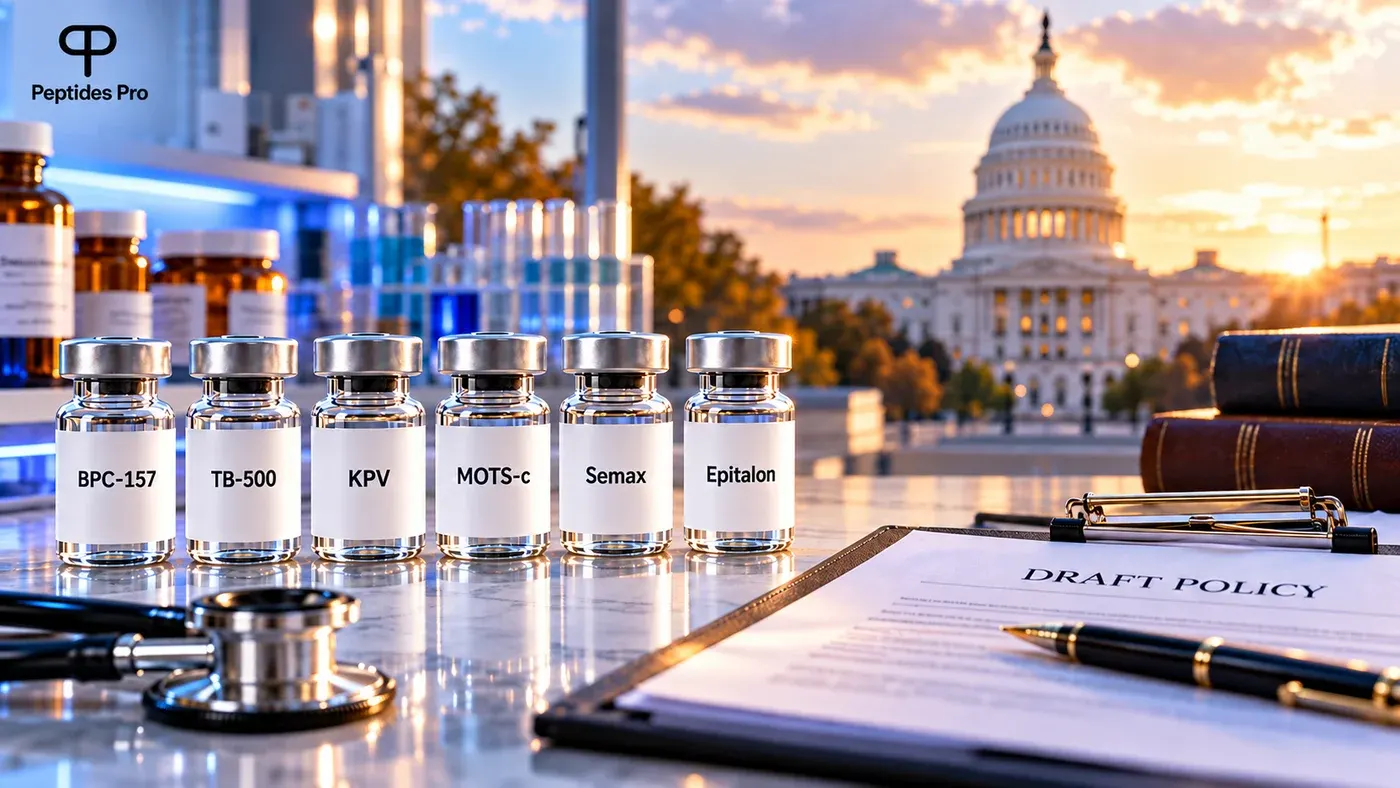
HHS has announced a U.S. compounding policy involving six widely discussed peptides. The public-inspection notice describes a draft enforcement policy, not approval of six new medicines. That distinction matters for patients asking when a pharmacy can dispense a specific preparation.
HHS has announced an enforcement-discretion policy for compounding certain peptide ingredients under section 503A of the Federal Food, Drug, and Cosmetic Act. Its Federal Register notice calls the accompanying policy a draft. The notice was filed for public inspection on October 28 and lists October 30 as its publication date.
What the announcement covers
Reporting on the announcement identifies BPC-157, TB-500, KPV, MOTS-c, Semax and epitalon as the six peptides in the plan. They were among the substances considered by the FDA's Pharmacy Compounding Advisory Committee in July. Reuters reporting on the six-peptide plan.
The announced approach concerns pharmacy compounding: preparing a medicine for an individual patient's needs. HHS says it does not intend to take enforcement action against qualifying state-licensed pharmacies, federal facilities or licensed physicians using ingredients within the policy's scope while the 503A bulk-substances list is developed through rulemaking.
Three dates readers should separate
The first date is the announcement and public-inspection filing, October 28. The second is the scheduled Federal Register publication, October 30. The third is any date specified for the policy's implementation in its operative text.
The notice invites written comments until two weeks after Federal Register publication. A comment window does not, by itself, establish when pharmacies can begin dispensing. Nor should an announcement date be substituted for an effective date without checking the relevant instructions.
We could verify the public-inspection notice for this report. We could not retrieve the linked HHS appendix directly, so we are not presenting its complete conditions or an implementation date as independently verified facts. Readers assessing a specific prescription need the current HHS policy and their pharmacy's interpretation of its requirements.
Access and approval answer different questions
FDA approval involves review of a particular medicine for specified uses. Compounded medicines do not receive that same premarket review for safety, effectiveness and quality. HHS repeats that distinction in the notice itself.
Enforcement discretion describes how an agency intends to use its enforcement authority. It does not turn every commercial vial bearing the same ingredient name into an approved medicine, establish that a peptide works for a particular condition, or validate a seller's purity claims.
HHS also reserves the possibility of revisiting the policy if safety signals or product-quality problems emerge. Anyone describing this as a permanent settlement is getting ahead of the document.
Before relying on the announcement
The next useful facts will be the final wording, the covered ingredient forms and conditions, and what licensed pharmacies actually make available within that framework. Formal rulemaking on the 503A list is another development to track separately.
For a proposed prescription, ask the pharmacy to identify the current operative policy, the exact ingredient form it covers and the conditions it is relying on. A social-media announcement cannot answer those product-specific questions.
Sources
Federal Register public-inspection notice, document 2026-22192
FDA July 23–24 advisory meeting and substance-specific materials
FDA explanation of compounded-drug risks
This article reports on policy and research reviewed on October 29, 2026. It is for educational purposes only and is not medical advice. No individual product, seller or treatment is endorsed.