
Education
Peptide Dosing Math Explained: Why It Confuses Everyone and How to Get It Right
Published Aug 15, 2026
Peptide dosing trips people up because you are working in three different unit systems at once. This guide explains the math, the common mistakes, and how to use a calculator to get your units right every time.
There is a specific moment almost every person who starts using peptides experiences. They have their vial. They have their bacteriostatic water. They have their syringe. And they are standing there, completely unsure whether to draw 10 units or 100 units, and suddenly aware that getting this wrong matters.
This confusion is not a sign of being bad at math. Peptide dosing genuinely does require keeping three separate unit systems in your head at the same time: the weight of the powder in milligrams, the dose you want in micrograms, and the volume on your syringe in units. Mixing any two of these up can mean taking ten times your intended dose.
The FDA has documented exactly this scenario in the real world. In reports about compounded semaglutide, they found patients who were directed to take 5 units and instead drew 50. One provider prescribed 0.25 mg (5 units) but the instruction was written in a way that led patients to draw 25 units — five times the intended dose. These were not careless people. They were operating in a system where the units of measurement are genuinely confusing.
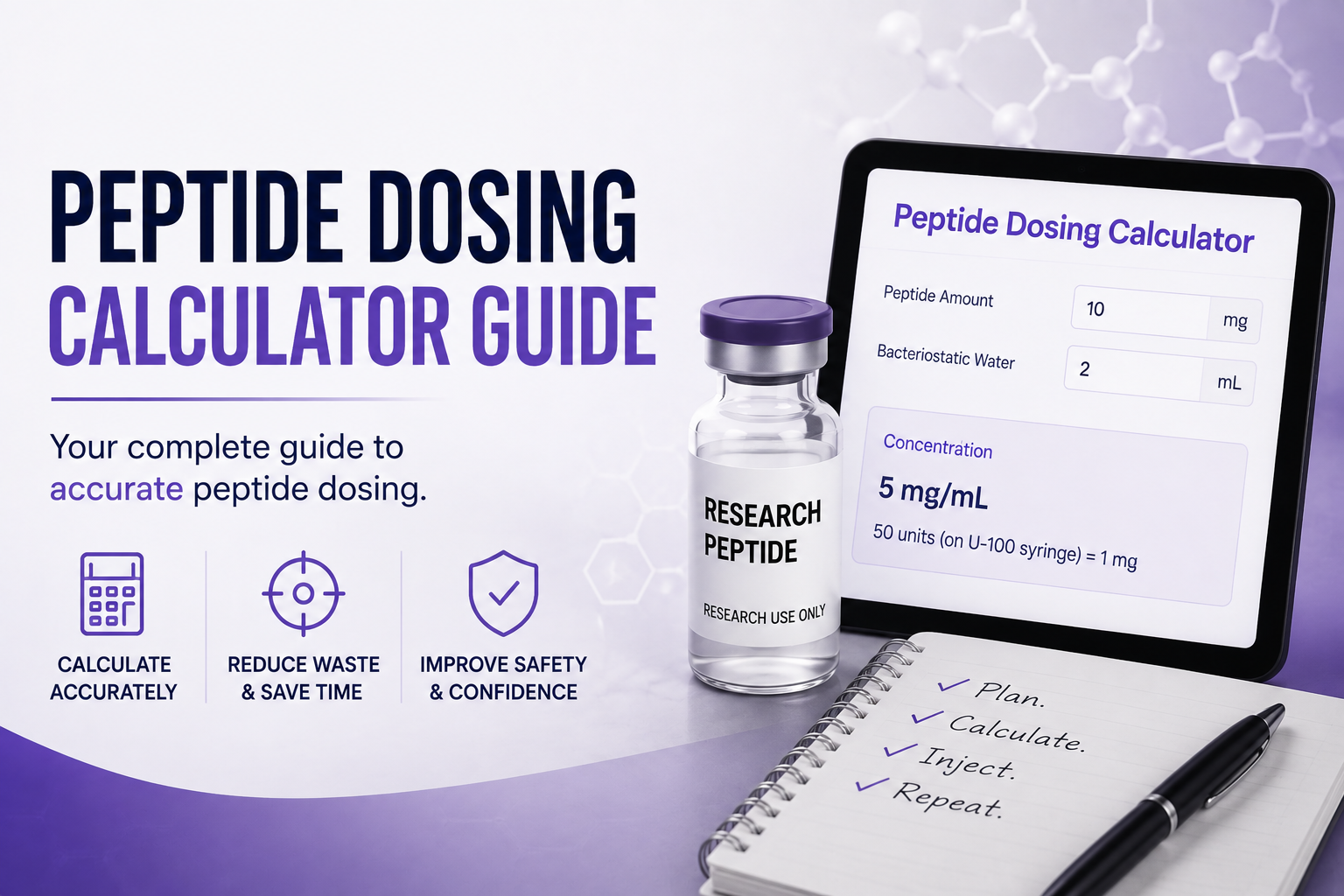
A peptide calculator solves this. You input three numbers, and it tells you exactly where to draw on your syringe. The Peptides Pro calculator does this for any compound and any vial size, for free.
But it also helps to understand why the math works the way it does — because that understanding is what lets you spot a mistake if something looks wrong.
The Three Unit Systems in Peptide Dosing
Milligrams (mg): This is how your vial is labelled. You buy a 5 mg vial of BPC-157 or a 10 mg vial of sermorelin. This is the total weight of the freeze-dried powder in the vial.
Micrograms (mcg): This is how your dose is measured. You want to inject 250 mcg or 500 mcg. Not milligrams.
The critical conversion: 1 mg = 1,000 mcg. This is where the majority of serious dosing errors happen. A vial containing 5 mg contains 5,000 mcg. If you calculate in milligrams when you should be calculating in micrograms, your answer is 1,000 times off in either direction.
Syringe units: Your insulin syringe is marked in units, where 100 units equals 1 mL. So 10 units is 0.10 mL. 50 units is 0.50 mL. This is the only measurement you actually control physically — you draw to a line on the syringe barrel.
Your target dose in mcg is not written on the syringe anywhere. The syringe only measures volume. To know which line on the syringe equals your dose, you need to know the concentration of your solution.
What Reconstitution Does to the Math
A lyophilised (freeze-dried) peptide vial contains powder. Before you can inject it, you add bacteriostatic water to dissolve it. The amount of water you add determines the concentration of your solution. Concentration is what connects your target dose in mcg to a volume on the syringe.
Here is the key relationship:
Concentration (mcg per unit) = (Vial mg × 10) ÷ mL of water added
Example: You have a 5 mg vial and add 2 mL of bacteriostatic water.
(5 × 10) ÷ 2 = 25 mcg per unit
This means every single unit on your syringe contains 25 mcg of peptide.
To find out how many units to draw for a 250 mcg dose:
250 ÷ 25 = 10 units
Draw to the 10-unit line.
Change the water volume and the entire calculation changes. Add 1 mL instead of 2 mL to that same 5 mg vial, and your concentration doubles to 50 mcg per unit — meaning a 250 mcg dose is now just 5 units. Same peptide, same dose target, completely different number on the syringe.
This is why "how many units should I take" has no answer without knowing how much water you used.
Why People Get This Wrong
They skip writing down the concentration. Once you calculate your concentration, you must record it and attach it to the vial. Every calculation you do from that point uses this number. Without it, you either recalculate from scratch each time (increasing the chance of error) or guess.
They confuse mg and mcg mid-calculation. The most common version: someone calculates that they need 0.250 mg but then draws 0.250 mL on the syringe, treating milligrams as if they were millilitres. These are different unit types and the numbers do not map directly.
They add a different amount of water than planned. Protocols often say "reconstitute with 2 mL." If you accidentally add 2.5 mL, your concentration changes and every subsequent dose is wrong. Consistency in reconstitution volume matters.
They use the wrong syringe. Standard insulin syringes in most markets are U-100 (100 units = 1 mL). If you use a U-40 syringe (common in some veterinary contexts), the unit markings are completely different. The same physical volume looks like a different number of units.
The Fastest Way to Get Your Units Right
The calculation above is a formula worth understanding once. But for every session, every vial, every dose adjustment, the practical answer is to use a calculator that does this for you without the risk of transcription error.
Use the Peptides Pro Peptide Calculator — you enter:
- Your vial size in mg
- The amount of bacteriostatic water you added in mL
- Your target dose in mcg
And it immediately tells you the concentration of your solution and exactly how many units to draw.
The calculation takes three seconds. The margin for error drops to essentially zero. And you get a reference you can come back to if you change your reconstitution volume or switch to a different vial size.
A Quick Reference for the Most Common Vial and Water Combinations
These are pre-calculated concentrations for the combinations most people actually use. The target doses shown are for reference.
| Vial Size | Water Added | Concentration | 250 mcg dose | 500 mcg dose |
|---|---|---|---|---|
| 5 mg | 1 mL | 50 mcg/unit | 5 units | 10 units |
| 5 mg | 2 mL | 25 mcg/unit | 10 units | 20 units |
| 5 mg | 2.5 mL | 20 mcg/unit | 12.5 units | 25 units |
| 10 mg | 2 mL | 50 mcg/unit | 5 units | 10 units |
| 10 mg | 5 mL | 20 mcg/unit | 12.5 units | 25 units |
| 2 mg | 1 mL | 20 mcg/unit | 12.5 units | 25 units |
The general principle: more water means lower concentration means more units per dose. A useful trick is to choose your water volume so that your target dose comes out to a round number of units (like 10 or 20) that is easy to draw accurately.
For 5 mg vials with a 250 mcg target dose, adding 2 mL gives you exactly 10 units — clean, easy to measure, hard to misread.
Body Weight Dosing: When It Applies
Most anecdotal and clinical protocols for peptides use fixed doses that do not change based on body weight. You take 250 mcg of BPC-157 regardless of whether you weigh 60 kg or 110 kg.
Some healing peptides in formal research contexts use weight-based dosing, typically expressed as mcg per kilogram. When this applies, the calculation adds one step:
Total dose (mcg) = Body weight (kg) × Dose per kg (mcg/kg)
Then calculate your units from there as normal. A 75 kg person on a 10 mcg/kg protocol needs 750 mcg. With a concentration of 25 mcg/unit (5 mg vial, 2 mL water), that is 30 units.
The Peptides Pro calculator handles weight-based dosing as well as fixed-dose protocols, so you do not need to run the multiplication manually.
Frequently Asked Questions
Can I change how much water I use in my next vial?
Yes, but you must recalculate your concentration from scratch when you do. Your previous unit draw amount is no longer valid. Many people pick a water volume and stick with it across all their vials of the same compound to keep the math consistent.
My calculation comes out to 7.5 units. Is that a problem?
No. Insulin syringes allow half-unit precision. Draw to the halfway point between 7 and 8. If half-unit precision feels uncomfortable, adjust your water volume so the target dose comes out to a whole number.
Does the amount of water affect how well the peptide works?
No. The peptide amount you are injecting is the same regardless of how dilute the solution is. A 250 mcg dose dissolved in 0.10 mL is identical in effect to 250 mcg dissolved in 0.25 mL — the dose is what matters, not the concentration.
What if I accidentally added more or less water than I intended?
Measure what you actually added, then recalculate your concentration based on the actual amount. Do not assume your intended volume and your actual volume are the same.
This article is for educational and informational purposes only. It does not constitute medical advice, diagnosis, or treatment. Consult a qualified healthcare professional before using any research peptide.
Use the Calculator
Before you apply any numbers from this guide, run your exact vial size, water volume, syringe size, and target amount through the calculator.