
Comparisons
Peptides vs Steroids: What's Actually Different?
Published Jun 26, 2026
Peptides and steroids are often mentioned together, but they're fundamentally different classes of compounds. Here's what you actually need to know about the distinction.
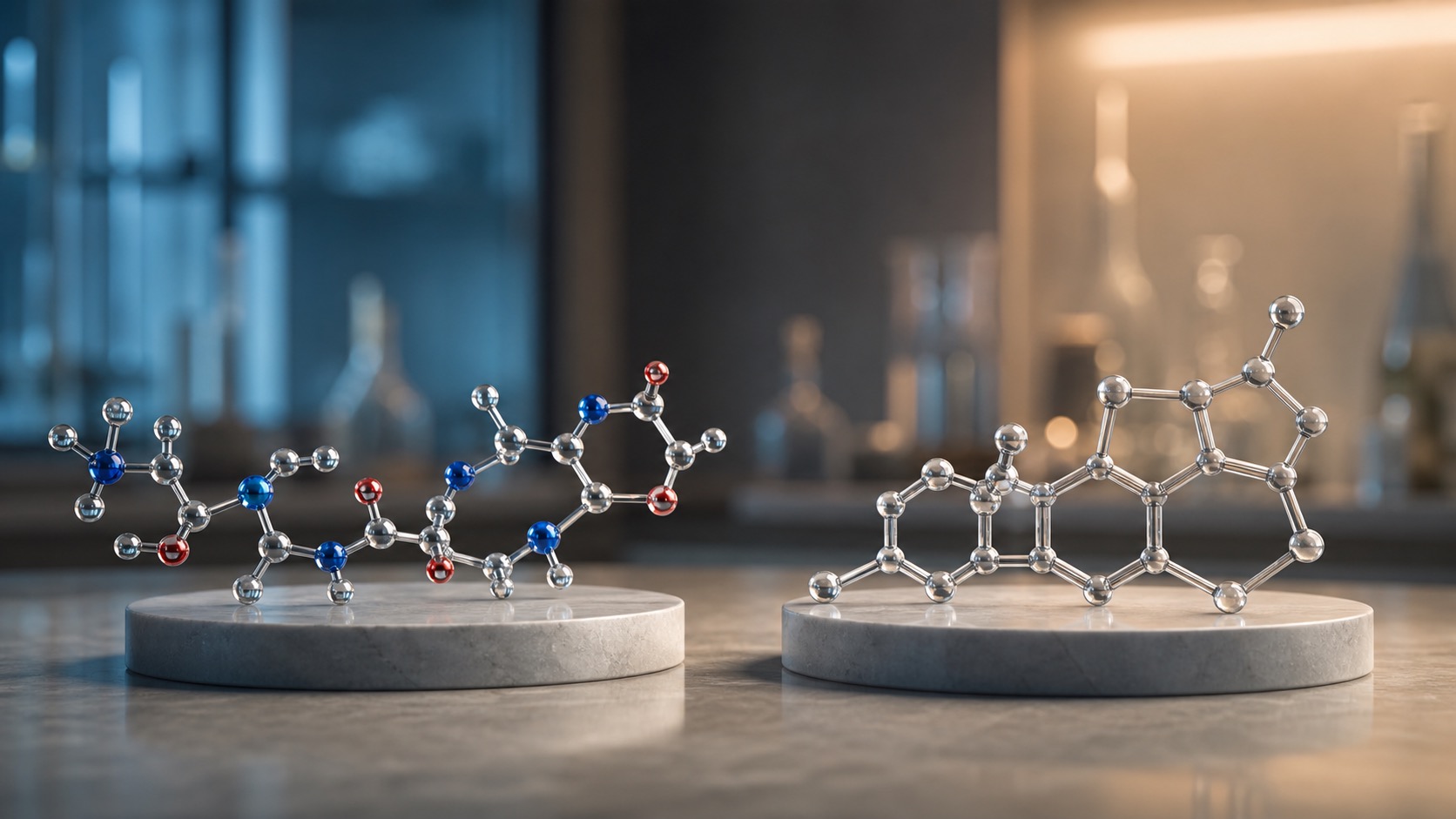
If you spend any time in fitness or biohacking communities online, you will notice that peptides and steroids often appear in the same conversation. Sometimes they are discussed as alternatives. Sometimes they are compared as if they compete for the same space. And sometimes — in Reddit threads and forum posts — the two categories get blurred together in ways that are genuinely misleading.
They are not the same thing. They are not even in the same chemical family. And understanding the difference has real implications for how you think about evidence, risk, and decision-making.
This is not an article that will tell you one is better than the other. It is an article that will explain what each actually is, how they differ mechanically, and why the comparison comes up so often.
Key Takeaways
- Steroids (anabolic-androgenic steroids) are synthetic derivatives of testosterone. Peptides are short chains of amino acids. They have fundamentally different chemical structures.
- Steroids directly influence androgen receptors and hormonal pathways in powerful, well-documented ways — with both documented effects and documented risks.
- Peptides act more like biological signals, influencing what the body does rather than acting as hormones themselves (though some peptides do affect hormonal pathways).
- Neither category is uniformly "safe" or "unsafe." Risk profiles depend heavily on the specific compound, the dose, the duration, and the individual.
- The regulatory and legal status of both categories varies significantly by country and compound.
What Steroids Actually Are
Anabolic-androgenic steroids (AAS) are synthetic compounds structurally derived from testosterone. The word "steroid" describes their chemical structure: they are built around a four-ring carbon skeleton. This family of molecules includes naturally occurring hormones like testosterone, estradiol, and cortisol — but in the context of performance and bodybuilding culture, "steroids" almost always refers to synthetic androgens.
These compounds work by binding to androgen receptors in muscle cells and other tissues, directly triggering changes in gene expression. The mechanism is well understood because it has been studied extensively for decades — both in clinical settings (testosterone replacement therapy, corticosteroid treatments) and in the context of sports doping research.
The documented effects of anabolic steroids include significant increases in muscle protein synthesis, red blood cell production, and recovery capacity. The documented risks include hormonal suppression of the body's natural testosterone production, liver stress with certain oral formulations, cardiovascular effects including changes to cholesterol and cardiac structure, and androgenic side effects including acne, hair loss, and in women, virilization. These are not theoretical concerns — they are well-established in clinical literature.
Steroids are controlled substances in many countries, including Schedule III controlled substances in the United States.
What Peptides Actually Are
Peptides are short chains of amino acids — the same molecular building blocks that make up proteins. The body produces peptides naturally and uses them extensively as signaling molecules: hormones, neurotransmitters, and regulatory signals are all peptide-based.
Synthetically produced peptides can mimic or modify these natural signals. Rather than acting as hormones themselves (as steroids do), most peptides work by stimulating, inhibiting, or modulating the body's own hormonal and cellular processes. This is an important mechanistic distinction.
For example, some peptides discussed in fitness contexts — growth hormone secretagogues — work by signaling the pituitary gland to release more of the body's own growth hormone. They are not growth hormone. They tell the body to make more of it. The downstream effects and risks are related but not identical to directly administering growth hormone.
Other peptides discussed in recovery contexts may interact with tissue repair signaling, inflammatory pathways, or cellular protective mechanisms. The specific mechanisms vary considerably by compound.
The Comparison That Keeps Coming Up
Reddit's biohacking communities discuss the "steroids vs peptides" comparison regularly, and it reflects a genuine decision point for people who are interested in performance or body composition and want to understand their options.
The most common framing goes something like this: steroids are more powerful but carry more risk. Peptides are more subtle and may be safer. This framing is not entirely wrong, but it is incomplete in several ways.
Power vs. subtlety: Anabolic steroids have a more direct and pronounced effect on muscle mass and performance — and more well-documented short-term results — than most peptides studied for similar purposes. Someone comparing the effects of testosterone to the effects of a growth hormone secretagogue will usually find the steroid more immediately impactful. But "more powerful" also means "more disruptive to endogenous hormone production."
Safety assumptions: The belief that peptides are automatically safer than steroids deserves scrutiny. Some peptides do have fewer documented adverse effects in the available research — but that research is often limited, and "less studied" is not the same as "safer." Unknown risk is a different kind of risk from documented risk, not a lower one.
Recovery of natural hormonal function: One frequently cited advantage of certain peptide approaches is that they may preserve or stimulate natural hormone production rather than suppressing it. Growth hormone secretagogues, if used and discontinued, may leave the endogenous system intact in ways that exogenous androgens often do not. But again, the clinical data on this is not comprehensive, and responses vary by individual.
Both carry regulatory concerns: Anabolic steroids are controlled substances in most Western countries. Many peptides discussed in performance contexts are also prohibited by WADA and other anti-doping bodies, and some are illegal to purchase without a prescription. The idea that peptides exist in a legally clean space is often inaccurate.
Where They Actually Overlap
The peptides-vs-steroids comparison sometimes becomes blurry because the two categories can affect similar outcomes — muscle recovery, body composition, hormonal environment — through different mechanisms.
Some peptide compounds used in performance contexts do interact with hormonal systems in significant ways. GHRH analogues and GH secretagogues, for instance, affect the growth hormone/IGF-1 axis meaningfully. These are not neutral "natural signal" compounds with zero systemic impact. They operate in overlapping territory with hormonal pharmacology, even if the mechanism is different.
This is why the framing of "peptides are natural / steroids are synthetic" does not hold up well. Many peptides used in performance contexts are synthesized in labs. The word "natural" says nothing reliable about either safety or effect.
Mike Israetel's Perspective on Performance Compounds
Discussions like the one in Mike Israetel's fitness content on steroids and performance compounds highlight something useful: experienced practitioners in competitive fitness often have a clear-eyed view of these tools that neither demonizes nor romanticizes them. The main takeaway from that type of conversation is that compounds of any kind are tools — and tools used without proper understanding of what they do, how they interact, and what the individual's biology is doing can cause harm regardless of the category they belong to.
The Bottom Line
Peptides and steroids are fundamentally different types of compounds with different mechanisms, different risk profiles, different evidence bases, and different regulatory statuses. The comparison matters because understanding the differences helps you ask better questions.
Neither category should be approached based on online enthusiasm alone. Both categories benefit from professional medical guidance, baseline testing, and honest assessment of what is known and what is not.
If you are comparing these options for a specific goal — and especially if you are an athlete subject to anti-doping policies — a conversation with a sports medicine physician or endocrinologist is far more useful than any forum thread.
Explore the Peptides Pro Global blog for dedicated articles on specific peptide compounds, or visit the Consultation page if you want to discuss your situation with someone qualified to help you navigate it.
FAQ
Are peptides legal and steroids illegal? It depends on the compound and the country. Anabolic steroids are controlled substances in many countries. Many peptides discussed in performance contexts are also prescription-only or regulated. Some are banned by anti-doping agencies. Legal status cannot be generalized across either category.
Can peptides replace steroids for bodybuilding? Not in terms of raw effect on muscle mass. Anabolic steroids have a more direct and powerful impact on muscle protein synthesis. Peptides typically work through more indirect mechanisms. They are not equivalent substitutes.
Are peptides safer than steroids? Not categorically. Some peptide compounds have a less dramatic adverse effect profile than anabolic steroids in the available research — but many are understudied in humans, and unknown risk is not the same as low risk. Both categories require medical guidance.
Do peptides suppress natural testosterone like steroids do? Growth hormone secretagogues do not typically suppress testosterone production the way exogenous androgens do. However, effects depend on the specific compound, and some peptides do affect hormonal systems meaningfully.
Where can I learn more about specific peptide compounds? The Peptides Pro Global blog covers specific compounds including BPC-157, TB-500, GHK-Cu, and GLP-1 agents in dedicated articles.
References
- Reddit Biohackers: Steroids vs Peptides — https://www.reddit.com/r/Biohackers/comments/1f2ngbc/steroids_vs_peptides/
- AMA: What Doctors Want Patients to Know About Injectable Peptides — https://www.ama-assn.org/public-health/prevention-wellness/what-doctors-want-patients-know-about-injectable-peptides
- Nature / Signal Transduction and Targeted Therapy: Advances in Peptide-Based Drug Development — https://www.nature.com/articles/s41392-024-02107-5
- Mike Israetel: Fitness, Steroids, and Performance Discussion — https://www.youtube.com/watch?v=TCk20JxchlQ
- Huberman Lab: Peptides — The Science, Uses & Safety — https://www.youtube.com/watch?v=_DfqnpSbMfE
Disclaimer: This article is for educational and informational purposes only. It does not constitute medical advice, diagnosis, or treatment. Peptides, injectable compounds, prescription medications, and health products may carry risks and may be regulated differently depending on your country. Always speak with a qualified healthcare professional before using peptides or making health-related decisions.