
Education
Semaglutide Reconstitution Calculator: How to Mix Your Vial and Calculate Every Dose
Published Aug 16, 2026
Compounded semaglutide comes as a powder in a vial. How you mix it determines your concentration, and your concentration determines how many units to draw for every single dose. Here is the full guide.
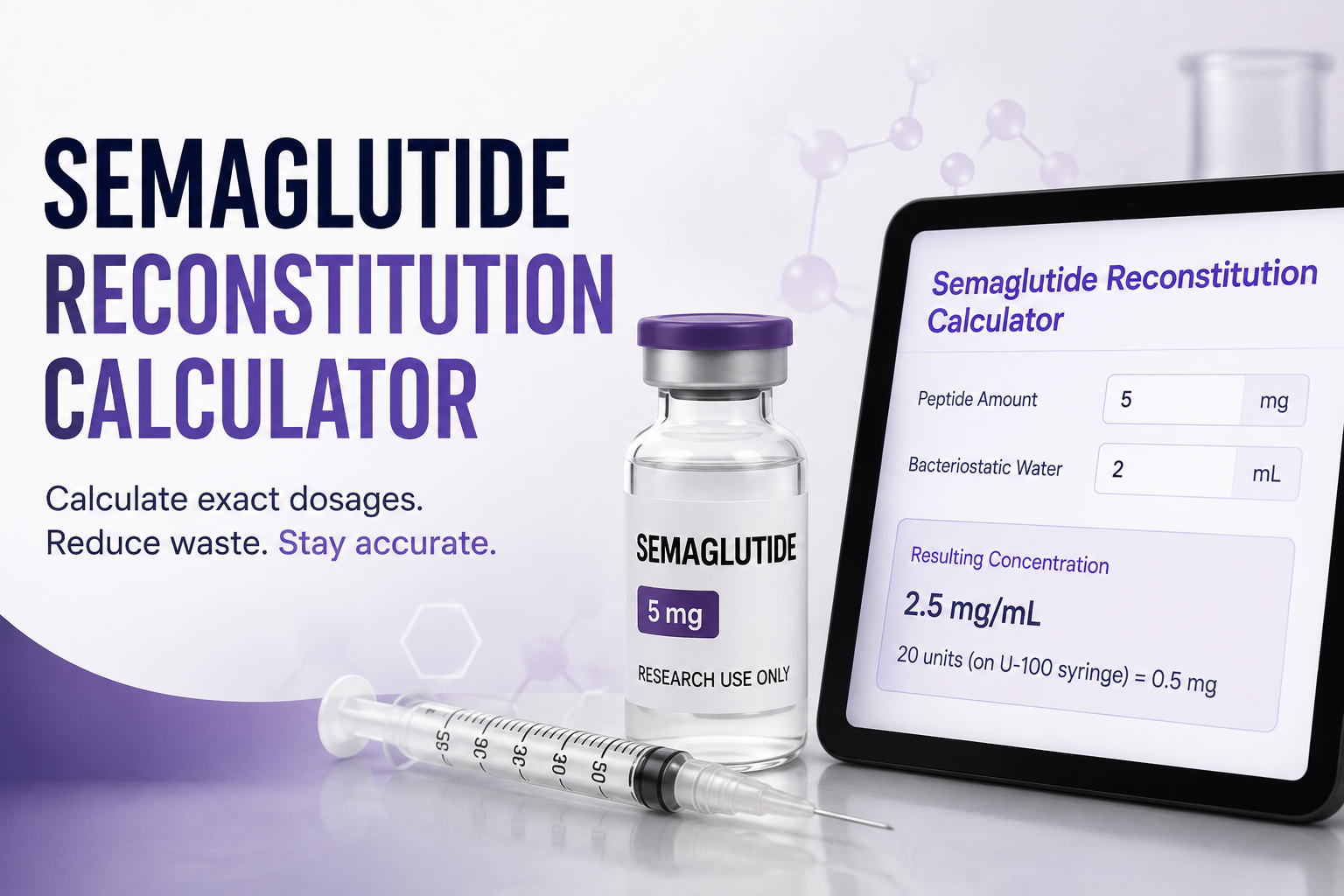
Compounded semaglutide most commonly arrives as a lyophilised (freeze-dried) powder in a vial that you reconstitute yourself. Unlike the branded pens (Ozempic, Wegovy), where each dose is pre-loaded and pre-measured, a compounded vial requires you to add bacteriostatic water and calculate your dose in syringe units yourself.
This is where the confusion starts, and it is not trivial confusion. The FDA has issued specific alerts about dosing errors with compounded semaglutide. The documented errors include patients drawing 50 units instead of 5, and providers prescribing 25 units when they meant 5. Some patients received five to ten times their intended dose.
The math is not complicated once you understand it. But there are three different unit systems involved, and mixing them up produces errors that look plausible until someone ends up with severe vomiting, dangerously low blood pressure, or an emergency room visit.
This guide walks through the reconstitution and dose calculation process step by step. For every actual dose you draw, use the Peptides Pro semaglutide calculator — it removes the risk of manual calculation error entirely.
Why Compounded Semaglutide Requires a Reconstitution Step
The branded GLP-1 pens (Ozempic for diabetes, Wegovy for weight management) come pre-mixed in liquid form, pre-dosed in a multi-dose injection pen. The dose dial is calibrated directly in milligrams. You set 0.25 mg, you inject 0.25 mg. There is no math involved.
Compounded semaglutide from a 503A pharmacy comes as powder for several practical reasons: lyophilised powder is more stable and has a longer shelf life than a pre-mixed solution, and it allows the pharmacy to compound at custom concentrations. You mix it yourself with bacteriostatic water according to the instructions provided, or according to your own calculated preference.
Once you mix it, you are working with a liquid solution at a specific concentration (mg per mL). Your dose target is expressed in mg (or mcg). Your syringe is marked in units. The connection between dose and units depends entirely on the concentration of your specific solution.
The Three Numbers You Need Before Every Dose
1. Vial size. How many mg of semaglutide are in the vial. Common compounded semaglutide vials: 2.5 mg, 5 mg, 10 mg. Check the pharmacy label.
2. Bacteriostatic water added. How many mL of BAC water you used during reconstitution. This is the variable that determines your concentration. If you used 2 mL versus 1 mL, your concentration (and therefore your units per dose) doubles.
3. Target dose. Your prescribed or protocol starting dose, expressed in mg. Typical starting doses for weight management: 0.25 mg per week. Titration follows a schedule (commonly 0.25 mg for 4 weeks, then 0.5 mg for 4 weeks, then 1 mg, then 1.7 mg, then 2.4 mg maximum).
Enter these three numbers into the Peptides Pro calculator and you get your exact units to draw. No multiplication required.
The Calculation: How Concentration Connects Dose to Units
The core formula
Concentration (mg/mL) = Vial mg ÷ Water mL added
Example: A 5 mg vial reconstituted with 2 mL of bacteriostatic water.
5 ÷ 2 = 2.5 mg per mL.
Now convert to mcg per unit (because your syringe is in units, not mL, and doses are often small enough to work in mcg):
2.5 mg/mL = 2,500 mcg per mL = 25 mcg per unit (because 100 units = 1 mL, so 1 unit = 0.01 mL, and 2,500 × 0.01 = 25)
Or using the shortcut: (Vial mg × 10) ÷ mL water = mcg per unit
(5 × 10) ÷ 2 = 25 mcg per unit.
Converting a dose from mg to units
Semaglutide doses are in milligrams, but the calculation is easier in mcg because syringe units are small volumes.
Target: 0.25 mg. Convert to mcg: 0.25 mg = 250 mcg.
At 25 mcg per unit: 250 ÷ 25 = 10 units.
Target: 0.5 mg = 500 mcg. At 25 mcg per unit: 500 ÷ 25 = 20 units.
Target: 1 mg = 1,000 mcg. At 25 mcg per unit: 1,000 ÷ 25 = 40 units.
Reconstitution Reference Table: Common Vial and Water Combinations
The table below gives pre-calculated units for the most common compounded semaglutide configurations. Find your vial size and water volume, then read across to your dose.
Units to draw for each dose target:
| Vial | Water | Concentration | 0.25 mg | 0.5 mg | 1 mg | 1.7 mg | 2.4 mg |
|---|---|---|---|---|---|---|---|
| 5 mg | 1 mL | 50 mcg/unit | 5 units | 10 units | 20 units | 34 units | 48 units |
| 5 mg | 2 mL | 25 mcg/unit | 10 units | 20 units | 40 units | 68 units | 96 units |
| 5 mg | 2.5 mL | 20 mcg/unit | 12.5 units | 25 units | 50 units | 85 units | 100 units+ |
| 10 mg | 1 mL | 100 mcg/unit | 2.5 units | 5 units | 10 units | 17 units | 24 units |
| 10 mg | 2 mL | 50 mcg/unit | 5 units | 10 units | 20 units | 34 units | 48 units |
| 10 mg | 4 mL | 25 mcg/unit | 10 units | 20 units | 40 units | 68 units | 96 units |
| 2.5 mg | 1 mL | 25 mcg/unit | 10 units | 20 units | 40 units | — | — |
The most common compounded semaglutide setup you will see across most protocols is a 5 mg vial with 2 mL of bacteriostatic water, giving 25 mcg/unit. This produces clean, easily drawn volumes across the standard titration range.
If your vial size or water volume is not in this table, the Peptides Pro peptide calculator handles any combination — just enter your specific numbers.
The Titration Schedule and What It Means for Your Units
The standard Wegovy titration schedule is the reference point for most compounded semaglutide protocols, though compounding pharmacies and prescribing physicians may use variations:
Weeks 1 to 4: 0.25 mg once weekly. Weeks 5 to 8: 0.5 mg once weekly. Weeks 9 to 12: 1 mg once weekly. Weeks 13 to 16: 1.7 mg once weekly. Week 17+: 2.4 mg once weekly (maintenance).
Using a 5 mg vial reconstituted with 2 mL (25 mcg/unit):
| Phase | Dose | Units |
|---|---|---|
| Weeks 1-4 | 0.25 mg | 10 units |
| Weeks 5-8 | 0.5 mg | 20 units |
| Weeks 9-12 | 1 mg | 40 units |
| Weeks 13-16 | 1.7 mg | 68 units |
| Week 17+ | 2.4 mg | 96 units |
Notice that as the dose increases across the titration schedule, the units required change substantially. Going from 0.25 mg (10 units) to 2.4 mg (96 units) is a nearly ten-fold difference in the volume you draw. Using the wrong dose from the schedule, or being unclear on which phase you are in, means a very different injection.
This is part of why the FDA's documented errors occurred: the difference between phase doses can be large, and if the written instruction was unclear (for example, writing "25 units" when the prescribed dose was 0.25 mg and the correct draw should have been "5 units"), the result is a significant overdose.
How the Volume of Bacteriostatic Water Changes Everything
This is the variable that creates the most confusion for people who receive compounded semaglutide from different pharmacies or who reconstitute their own vials differently each time.
Consider a 5 mg vial:
- Reconstituted with 1 mL: concentration is 50 mcg/unit. A 0.5 mg dose = 10 units.
- Reconstituted with 2 mL: concentration is 25 mcg/unit. A 0.5 mg dose = 20 units.
- Reconstituted with 4 mL: concentration is 12.5 mcg/unit. A 0.5 mg dose = 40 units.
Same vial. Same dose target. Three different unit amounts. If you previously used 2 mL and switch to 1 mL without recalculating, you will draw half the intended dose. If you switch from 1 mL to 2 mL without recalculating, you will draw twice the intended dose.
The rule: whenever you reconstitute a new vial or change your water volume, recalculate everything. Old unit numbers do not carry forward.
Choosing Your Water Volume: Practical Considerations
The goal is to choose a water volume that puts your current and future titration doses in a range of 5 to 50 units on the syringe. Less than 5 units is difficult to draw accurately on a standard insulin syringe. More than 50 units starts requiring careful positioning on the syringe barrel.
For someone early in the titration schedule (0.25 mg to 0.5 mg), a more dilute solution (more water, lower concentration) is often better because it gives a larger, more measurable draw volume.
For someone at maintenance doses (1.7 mg to 2.4 mg), a more concentrated solution (less water) keeps the draw volume manageable.
Recommendation for a 5 mg vial across a full titration protocol: 2 mL gives the most practical range across all titration phases, with doses ranging from 10 units (0.25 mg) to 96 units (2.4 mg). The 96-unit draw is close to the full capacity of a standard 1 mL insulin syringe and works fine, though some users prefer two draws for the highest doses.
What Happens If You Make a Calculation Error
The dose-response relationship for semaglutide is non-linear. A small increase in dose at the high end of the titration schedule produces much more pronounced nausea, vomiting, and cardiovascular effects than the same percentage increase at lower doses.
The documented real-world outcomes from calculation errors include:
Patients who drew 5x their intended dose and presented with severe nausea, vomiting, persistent hypoglycaemia, and in some cases required emergency medical care. The symptoms are not always immediate — semaglutide has a long half-life (~7 days), so the effects of an overdose can persist for several days after a single incorrect injection.
Patients who drew 1/5 of their intended dose experienced no significant effect from the dose, but may have drawn incorrect conclusions about semaglutide not working for them.
Both outcomes are avoidable. The calculator exists precisely to remove human arithmetic from the process. Use the Peptides Pro calculator for every reconstitution and every dose.
When to Recalculate
You must recalculate your units whenever:
- You open a new vial (even if it appears to be the same size as the last one — verify the label)
- You change the amount of bacteriostatic water you use
- You move to the next phase of your titration schedule
- Your pharmacy changes the vial concentration
- You switch between different compounding pharmacies
You do not need to recalculate for each dose from the same vial, as long as the vial size and water volume have not changed. Write your concentration and your current units-per-dose on a label and attach it to the vial.
Injection Site and Technique for Compounded Semaglutide
Semaglutide is administered subcutaneously. Standard sites are the abdomen (2 to 3 cm from the navel), upper thighs, and upper outer arms. Rotate sites with each weekly injection to prevent lipodystrophy.
Use a short, fine-gauge needle (4 to 8 mm, 29 to 32 gauge is typical for subcutaneous use). Pinch a fold of skin, insert at 45 to 90 degrees, inject slowly, hold for 5 to 10 seconds before withdrawing to prevent leakage.
The units of your dose are a volume measurement, not a pressure or speed measurement. Draw slowly, inject slowly.
This article is for educational and informational purposes only. It does not constitute medical advice, diagnosis, or treatment. Semaglutide is a prescription medication in most jurisdictions. Consult a qualified healthcare professional before use. Do not self-administer compounded medications without medical supervision.
Use the Calculator
Before you apply any numbers from this guide, run your exact vial size, water volume, syringe size, and target amount through the calculator.