
Education
They Bought BPC-157, PT-141 and Retatrutide. The Lab Found Something Else.
Published Oct 22, 2026
WIRED bought four injectable products and sent them for independent testing. None contained a detectable match for its labelled ingredient. Here's what the investigation uncovered.
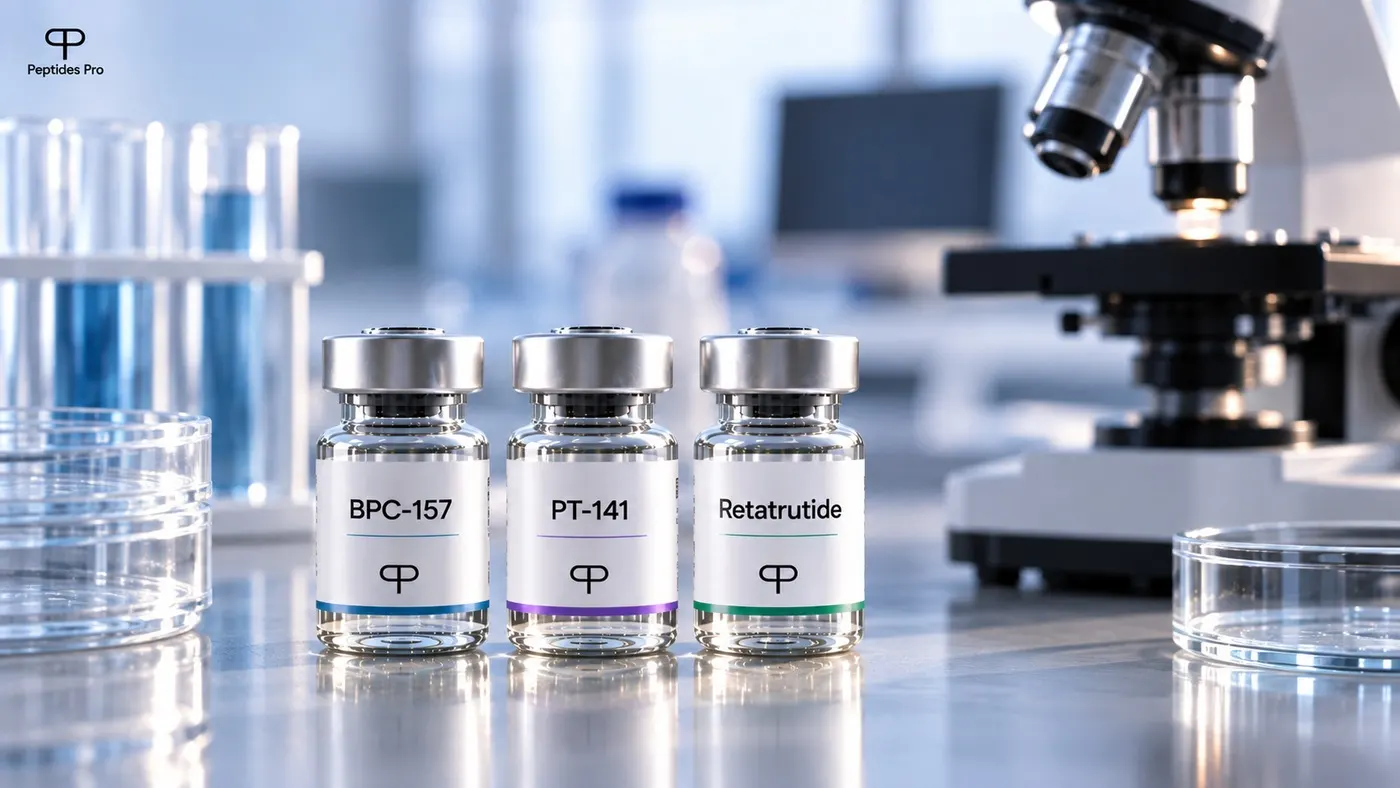
Four tiny vials.
A Brooklyn convenience store.
And a laboratory test that raised a much bigger question:
What if the substance printed on a peptide vial is not actually inside it?
On September 15, 2026, WIRED published an investigation into injectable products being sold at Mr. Green, a convenience store on Bedford Avenue in Brooklyn.
Reporters spent $376.20 on four products from a vendor called INDR Labs.
The labels identified them as:
- BPC-157
- PT-141
- retatrutide
- NAD+
The products were sent for independent laboratory testing.
None of WIRED's four samples produced a detectable match for the active ingredient identified on the label.
The BPC-157 sample did not produce a detectable match for BPC-157.
The retatrutide sample did not produce a detectable match for retatrutide.
The same fundamental problem occurred with the PT-141 and NAD+ samples.
But there is an equally important limitation:
The testing did not establish exactly what all four vials contained instead.
That distinction matters.
The investigation did not prove that every vial contained a dangerous substitute.
It did not prove that the samples were simply water.
It showed something more basic:
The purchased products could not be analytically confirmed as the substances printed on their labels.
WIRED sent the products through Finnrick, an independent testing service based in Austin that coordinates analyses through external laboratories.
The testing examined whether the samples matched the substances they claimed to contain, along with certain contamination-related characteristics.
The central identity result was the same across all four products.
| Product label | What it is associated with | WIRED's finding |
|---|---|---|
| BPC-157 | Experimental recovery and tissue-repair research | No detectable match for labelled BPC-157 |
| PT-141 | Bremelanotide-related sexual-health treatment | No detectable match for labelled compound |
| Retatrutide | Investigational metabolic medicine | No detectable match for retatrutide |
| NAD+ | Longevity and wellness market | No detectable match for labelled NAD+ |
NAD+ is not itself a peptide.
Its inclusion reflects how peptides and other injectable wellness products are commonly marketed together.
The laboratory could not definitively answer that question.
Its analysis was designed primarily to determine whether the submitted samples matched specified reference substances.
It was not an unrestricted chemical investigation capable of identifying every unknown compound present.
The failure to confirm the labelled ingredients therefore leaves several possibilities.
The products might have been:
- incorrectly labelled
- chemically different from the substances advertised
- degraded before testing
- otherwise unsuitable for confident identification
WIRED reported degradation as one possible explanation because peptide stability can depend heavily on storage conditions.
The investigation did not establish which explanation applied.
The scientifically defensible conclusion is narrower:
The labels made specific chemical claims that the laboratory could not verify.
Peptide marketing frequently focuses on numbers such as:
99 percent purity.
But before purity becomes meaningful, identity has to be established.
Imagine a vial says:
BPC-157.
A laboratory first needs to establish whether the material actually corresponds to BPC-157.
Only then does it make sense to interpret tests describing the purity or quantity of that identified substance.
If the identity cannot be established, a high-looking purity percentage from an unrelated or unreliable document does not solve the problem.
WIRED also reported on testing arranged separately by Jeff Colhoun of Peptide Critic.
He purchased four INDR Labs products from another Brooklyn store:
- two labelled retatrutide
- two labelled NAD+
The samples were sent to Analytical Formulations in Texas.
The laboratory reported that it could not positively identify the labelled substances.
That wording is important.
It should not be rewritten as:
"The laboratory proved the substances were completely absent."
A failed positive identification means the laboratory could not establish the claimed identity with sufficient confidence.
Across the two investigations, eight products from the same vendor were examined through two separate testing routes.
None produced a confirmed identity match.
That does not establish how common mislabelling is across the entire peptide market.
Eight samples are not a national prevalence study.
But they show that the problem can occur.
The laboratory findings were not the first questions raised about INDR Labs.
On July 2, 2026, CBS News investigated retatrutide being sold at Mr. Green.
A reporter purchased a vial advertised as retatrutide for $95.
CBS reported that no prescription, medical questionnaire or age verification was required.
The vendor's website promoted third-party testing and displayed Certificates of Analysis.
CBS then identified irregularities in those documents.
One report associated with a retatrutide product appeared to contain analytical information referring instead to tirzepatide.
More importantly, the certificate identified Vanguard Laboratory as the testing laboratory.
CBS contacted Vanguard.
The laboratory denied issuing the reports and said INDR Labs was not its client.
Read the CBS News investigation
Vanguard later published its own statement discussing the disputed certificates.
Read Vanguard Laboratory's statement
This should be kept separate from the WIRED test results.
One concerns product identity.
The other concerns whether laboratory documentation used to support product claims was authentic.
A Certificate of Analysis can look authoritative.
It may contain:
- a laboratory logo
- chromatograms
- mass spectra
- purity percentages
- batch numbers
- signatures
- technical terminology
But the value of the document depends on whether:
- the laboratory actually issued it
- the sample can be traced to the product being sold
- the batch matches
- the analytical method is appropriate
- the result is being interpreted correctly
A fabricated certificate can create the appearance of scientific verification when no such verification occurred.
A genuine certificate can also be misused if it applies to a different batch or if a narrow purity test is presented as proof of complete safety.
WIRED reported low levels of heavy metals and bacterial endotoxins in the samples tested.
That is useful information.
It is not a complete safety assessment.
Low measured levels of those contaminants do not establish:
- sterility
- correct chemical identity
- correct quantity
- absence of every contaminant
- clinical safety
- suitability for injection
Endotoxin testing and sterility testing answer different questions.
Chemical identity is another question again.
The samples therefore should not be described as safe simply because certain contamination measurements were relatively low.
One day before WIRED published its investigation, Australia's Therapeutic Goods Administration issued a safety alert about a separate product sold as retatrutide.
A consumer experienced uncontrollable vomiting after using the product.
The vomiting resulted in a torn oesophagus and hospital treatment.
The TGA obtained a sample and tested it.
In this case, the regulator identified what was present.
The product contained:
- no retatrutide
- undeclared semaglutide
The amount of semaglutide detected was approximately eight times higher than the level found in semaglutide products assessed by the TGA and included in the Australian Register of Therapeutic Goods.
This case should not be merged with WIRED's findings.
WIRED did not report that its retatrutide sample contained semaglutide.
The Australian regulator did.
| Question | WIRED Brooklyn investigation | Australian TGA investigation |
|---|---|---|
| Labelled product | Four products including retatrutide | Retatrutide |
| Was the labelled ingredient confirmed? | No | No |
| Was a replacement active drug identified? | Not definitively | Yes, semaglutide |
| Was serious harm documented from the tested product? | Not established | Yes, hospital-treated serious adverse event |
| Main lesson | Product identity could not be verified | Confirmed misidentification with an undeclared active drug |
The Australian case demonstrates one possible consequence of mislabelling:
A person may receive a pharmacologically active drug they did not know they were taking.
On October 21, 2026, CBS News published a separate investigation involving products sold as retatrutide.
Researchers testing another bodega sample reported that it did not resemble a peptide.
Further analysis identified phenylacetic acid and detected bacterial colonies in that particular sample.
Read the October 2026 CBS investigation
This is another separate sample and another separate investigation.
It should not be used to claim that WIRED's four samples contained phenylacetic acid or bacteria.
The broader pattern is the important point:
Products sold under the same scientific name can produce very different analytical findings when they originate outside regulated pharmaceutical manufacturing.
Retatrutide is being developed by Eli Lilly as an investigational metabolic medicine acting through GIP, GLP-1 and glucagon receptor pathways.
Its clinical results have generated enormous interest.
But clinical-trial success does not make an investigational product commercially approved.
As of October 2026, retatrutide is not an FDA-approved medicine.
FDA states that retatrutide:
- is not a component of an FDA-approved drug
- has not been found safe and effective for any condition through FDA approval
- cannot be used in compounding under US federal law
Read FDA's current information on unapproved GLP-1 products
This means a vial sold online as retatrutide is not equivalent to the investigational medicine used in Eli Lilly's controlled clinical trials simply because it carries the same molecule name.
Clinical trials use products manufactured under defined development and quality systems.
An unrelated commercial vial may differ in:
- chemical identity
- purity
- concentration
- formulation
- sterility
- degradation
- storage
- manufacturing controls
So when a clinical trial reports a result with authentic investigational retatrutide, that result cannot automatically predict what will happen with a product whose identity has not even been established.
BPC-157 is experimental.
Animal and laboratory studies have generated interest around tissue repair and gastrointestinal biology.
Human evidence remains limited and methodologically weak.
FDA has raised concerns about limited safety information, immunogenicity, impurities and product characterisation.
The WIRED investigation creates another layer of uncertainty.
Before asking whether BPC-157 works, the product first needs to contain BPC-157.
A study of authentic BPC-157 cannot predict the effects of an unidentified substance sold under the same name.
PT-141 is associated with bremelanotide.
Bremelanotide is the active ingredient in the FDA-approved prescription medicine Vyleesi.
Vyleesi is approved for acquired, generalised hypoactive sexual desire disorder in certain premenopausal women.
Its approval is specific.
It does not apply to every sexual-health claim or every research vial labelled PT-141.
View FDA prescribing information for Vyleesi
WIRED's sample labelled PT-141 failed to produce a detectable match for the claimed active ingredient.
That finding concerns the purchased sample.
It does not call into question the identity of the regulated FDA-approved medicine.
The four products WIRED bought were not one scientifically uniform group.
BPC-157 is an experimental peptide.
Retatrutide is an investigational medicine.
Bremelanotide has an approved pharmaceutical product for a specific indication.
NAD+ is not a peptide at all.
The common factor was the way they were sold within the same wellness and research-product ecosystem.
This is why the word peptide should never substitute for identifying the exact compound and product.
The investigations do not establish exactly where the failures occurred.
Several vulnerabilities are possible.
Upstream supplier uncertainty
A retailer or brand may rely on another company for finished vials or bulk material.
That supplier may rely on additional suppliers.
Traceability can become difficult.
Inadequate identity testing
If a business accepts material without confirming its identity, an error can travel through the supply chain.
Storage and degradation
Some peptides can degrade under unsuitable environmental conditions.
WIRED identified degradation as one possible explanation for its findings.
The investigation did not establish that degradation was the cause.
Unreliable documentation
A seller can display a laboratory report that is unrelated to the current batch.
More seriously, the laboratory named on a document may not have issued it at all.
The documented events occurred in the United States and Australia.
They do not establish that peptide products sold in Bali have the same problems.
There is no evidence from these investigations that all Bali peptide products are fake.
But the lessons apply anywhere imported research products are being evaluated.
Three separate questions matter.
| Question | What can help answer it? |
|---|---|
| Is the product actually what the label claims? | Appropriate identity testing connected to the actual batch |
| Does the product meet relevant quality standards? | Analytical testing, manufacturing controls and traceable documentation |
| Is it authorised as a medicine for the intended use? | Verification through the relevant regulator |
For Indonesian products, BPOM provides an official product database.
A BPOM registration for one manufacturer's medicine does not automatically extend to every product using the same active ingredient name.
Likewise, a laboratory report does not create marketing authorisation.
A legitimate COA can provide useful analytical information.
Depending on the methods used, it may help answer:
- identity
- purity
- content
- certain impurity questions
But it cannot by itself establish:
- medical effectiveness
- long-term safety
- appropriate prescribing
- regulatory approval
- sterility unless sterility is actually evaluated appropriately
- equivalence to an approved or investigational pharmaceutical product
For a deeper explanation, see:
"The lab found nothing, so the vials were just water"
Not established.
WIRED failed to confirm the labelled active substances.
It did not completely characterise every component.
"The contaminant results were low, so the products were safe"
No.
Testing a few contamination categories does not establish full product safety or sterility.
"All eight vials were proven to contain zero active ingredient"
That overstates the findings.
WIRED's four samples did not produce detectable matches for their labelled substances.
The four additional samples tested separately could not be positively identified.
"This proves every research peptide seller is selling fake products"
No.
The investigations involved specific products and vendors.
They do not establish a prevalence rate for the entire market.
"A COA guarantees the product is genuine"
No.
A COA must be authentic, batch-specific and relevant to the tests being claimed.
"Research use only means the product is approved for research and therefore safe"
No.
A research-use label does not establish pharmaceutical quality, clinical safety, effectiveness or approval for human treatment.
What Did WIRED Find?
WIRED purchased products labelled BPC-157, PT-141, retatrutide and NAD+ from a Brooklyn convenience store.
Testing failed to produce a detectable match for the claimed active ingredient in any of the four samples.
The complete composition of the samples was not established.
Which Company Supplied the Products?
The products were branded INDR Labs.
WIRED reported that the company did not respond to its questions.
Did the BPC-157 Sample Contain Another Peptide?
WIRED did not identify a specific replacement peptide.
The sample failed to produce a detectable match for BPC-157.
Was WIRED's Retatrutide Actually Semaglutide?
No such finding was reported in WIRED's investigation.
A separate Australian TGA investigation identified undeclared semaglutide in a different counterfeit retatrutide product.
Did Any Investigation Find Bacteria?
A separate CBS investigation published on October 21, 2026 reported bacterial colonies in another bodega product sold as retatrutide.
That finding should not be transferred to WIRED's samples.
Are All Online Peptides Fake?
There is no evidence supporting that conclusion.
The investigations show that misidentified products exist.
They do not establish how common the problem is across all sellers.
Can Independent Testing Detect Fake Products?
Appropriate analytical testing can help determine whether a submitted sample matches a claimed compound.
Different tests are needed for questions such as:
- quantity
- impurities
- sterility
- endotoxin
- microbial contamination
Reliable batch and sample traceability are also essential.
WIRED began with a simple question:
Do these injectable products actually contain the substances printed on their labels?
For the four products it purchased, the answer could not be confirmed.
A separate investigation of four additional products from the same vendor produced similar identity concerns.
Earlier reporting also established that a laboratory denied issuing certificates attributed to it.
Australia's TGA then documented a different type of failure: a product sold as retatrutide contained undeclared semaglutide instead.
And a later October 2026 CBS investigation identified yet another problematic bodega sample.
These findings do not prove that every peptide seller is dishonest.
They do not prove that every online peptide is fake.
But they demonstrate why packaging, product names and laboratory-looking paperwork should not be treated as proof of chemical identity.
Before asking whether an experimental compound works, there is an even more basic question:
Does the vial actually contain the substance being discussed?
For the samples at the centre of these investigations, that question became the story.
Original September 15, 2026 investigation documenting the purchase and testing of BPC-157, PT-141, retatrutide and NAD+ products.
July 2026 investigation into retail retatrutide sales and laboratory certificates attributed to Vanguard Laboratory.
Laboratory statement discussing certificates attributed to Vanguard that the laboratory says it did not issue.
Official Australian regulatory alert documenting undeclared semaglutide and no retatrutide in a tested product associated with a serious adverse event.
Current FDA information confirming that retatrutide is not a component of an FDA-approved drug and cannot be used in compounding under federal law.
Official prescribing information for the FDA-approved bremelanotide medicine.
Separate October 21, 2026 investigation involving additional products marketed as retatrutide.
Medical Disclaimer
This article is provided for educational and research-information purposes only and does not provide medical advice, diagnosis or treatment recommendations.
Experimental and unverified peptide products may contain unidentified, incorrectly labelled or otherwise inadequately characterised substances, and their safety and effectiveness may not be established. If you experience symptoms that could represent a medical emergency, seek urgent medical care. Personal medical decisions should be discussed with a qualified healthcare professional.
This article is for educational purposes only and does not replace medical advice.