
Regulation
Understanding the FDA's Review of Popular Peptides: Key Takeaways from Dr. Ashley Froese
Published Jul 14, 2026
An educational overview of Dr. Ashley Froese's discussion on the FDA's review of several widely discussed peptides, why the review matters, and what consumers should understand about scientific evidence and regulatory oversight.
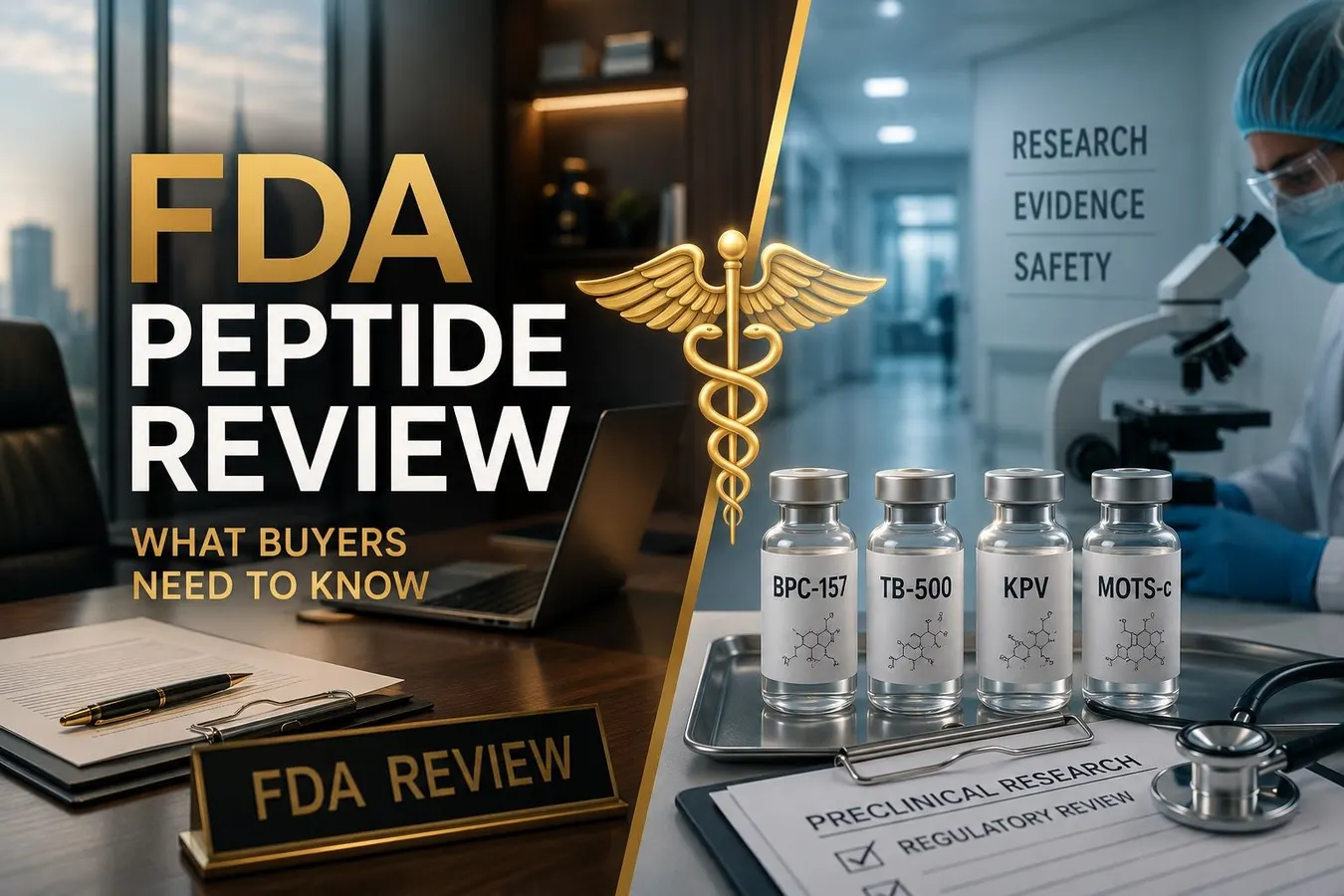
Peptides continue to attract attention across the wellness, longevity, and performance communities. Researchers are studying a growing number of peptide compounds, while consumers are increasingly exposed to information through social media, podcasts, and online marketing.
In a recent discussion, Dr. Ashley Froese examined an upcoming review by the U.S. Food and Drug Administration's (FDA) Pharmacy Compounding Advisory Committee (PCAC). Rather than debating whether peptides are "good" or "bad," the discussion focused on how scientific evidence is evaluated, why regulatory reviews matter, and how buyers should interpret ongoing research.
The overall message was consistent throughout the presentation: science should guide decisions not hype.
Dr. Ashley Froese is known for creating educational content focused on peptide science, clinical research, and evidence based wellness. His work often explains emerging research while encouraging viewers to distinguish between promising scientific findings and marketing claims.
Throughout the discussion, he emphasized that regulatory reviews exist to examine available evidence rather than confirm or reject popular opinions circulating online.
According to Dr. Froese, the FDA review is focused on evaluating available scientific evidence relating to several peptide substances that have generated interest within research and wellness communities.
He explained that the committee is not determining whether peptides generally "work." Instead, it reviews evidence relevant to specific regulatory questions that may influence future decisions involving compounded products.
For consumers, this distinction is important. A regulatory review should not be interpreted as a blanket endorsement or rejection of products that may be discussed online.
Dr. Froese discussed several peptide substances that have attracted significant research interest. His comments centered on the current state of scientific investigation and the importance of interpreting findings carefully.
BPC-157
Dr. Froese noted that BPC-157 is one of the most widely discussed peptides in wellness communities. He explained that research has explored it in laboratory and animal settings, particularly in relation to tissue biology and gastrointestinal research.
He also emphasized that much of the public discussion extends beyond what has been established in human clinical research. While interest remains high, he encouraged viewers to recognize the difference between early research findings and well-established clinical evidence.
TB-500 (Thymosin Beta-4)
The discussion also included TB-500, a peptide related to the naturally occurring protein Thymosin Beta-4.
Dr. Froese explained that researchers have investigated its role in biological processes involved in tissue repair and cell movement. He pointed out that these scientific questions continue to be explored and that consumers should avoid assuming that ongoing research automatically translates into proven clinical outcomes.
KPV
Dr. Froese described KPV as another peptide currently being investigated in scientific research. He explained that researchers are studying its biological activity and inflammatory pathways, but also stressed that evidence should be interpreted carefully.
He encouraged viewers to distinguish between promising laboratory findings and conclusions that require stronger human clinical evidence.
MOTS-c
The discussion also covered MOTS-c, a peptide associated with mitochondrial biology and cellular energy regulation.
Dr. Froese explained that researchers are investigating how it may influence metabolic pathways and exercise physiology. Much of the available evidence remains preclinical, and he noted that additional human research is needed to better understand its significance.
One of the strongest themes throughout the discussion was the difference between scientific research and commercial marketing.
Scientific research develops gradually through laboratory work, peer reviewed publications, and clinical investigation. Marketing, by comparison, often moves much faster and may emphasize promising findings before stronger evidence becomes available.
Dr. Froese encouraged consumers to evaluate information critically and avoid relying solely on testimonials, social media trends, or promotional language.
Another important point raised during the discussion was the distinction between laboratory studies, animal research, and human clinical research.
Early stage research helps scientists understand biological mechanisms and identify areas worthy of further investigation. However, findings from laboratory or animal studies do not always predict outcomes in people.
This is one reason regulatory agencies continue to evaluate evidence carefully before making decisions.
Whether someone is new to peptides or has followed the field for years, Dr. Froese's discussion highlighted several practical lessons.
Consumers should consider:
- Looking for evidence rather than marketing claims.
- Understanding that research continues to evolve.
- Recognizing the difference between early research and established clinical evidence.
- Researching suppliers carefully.
- Seeking transparency regarding product quality and documentation.
- Consulting qualified healthcare professionals before making health related decisions.
An informed buyer is generally better positioned to evaluate new information responsibly.
Does an FDA review mean a peptide has been approved?
No. Regulatory reviews are part of an evidence evaluation process and should not be interpreted as product approval.
Why are these reviews important?
They help regulators assess available scientific information, research quality, and other relevant evidence before making regulatory decisions.
Why does Dr. Froese emphasize evidence?
Because scientific conclusions are strongest when supported by high quality, reproducible human research rather than isolated studies or anecdotal reports.
Should consumers rely on online success stories?
Personal experiences may be interesting, but they do not replace carefully conducted scientific research.
What is the main takeaway from Dr. Froese's discussion?
His central message is that consumers should remain curious while allowing scientific evidence not hype to guide their understanding of peptides.
The popularity of peptides continues to grow, but so does the importance of understanding the science behind them. Dr. Ashley Froese's discussion serves as a reminder that regulatory reviews are designed to examine evidence carefully rather than reinforce marketing narratives.
For consumers, the most valuable approach is to remain informed, evaluate information critically, and recognize that scientific understanding develops over time. As new research emerges and regulatory reviews continue, evidence not speculation should remain the foundation for informed decision making.
This article is provided for educational and informational purposes only. It does not constitute medical advice, diagnosis, or treatment. It summarizes a public discussion and current regulatory context and should not be interpreted as endorsing any specific product or substance. Readers should consult qualified healthcare professionals regarding personal health decisions and rely on reputable sources when evaluating wellness products.