
Education
What 'Research Peptides' Actually Means (And What It Doesn't)
Published Jul 28, 2026
The phrase 'research use only' is on almost every peptide sold online. Here is what that label legally means, what it doesn't cover, and what it tells you about product quality.
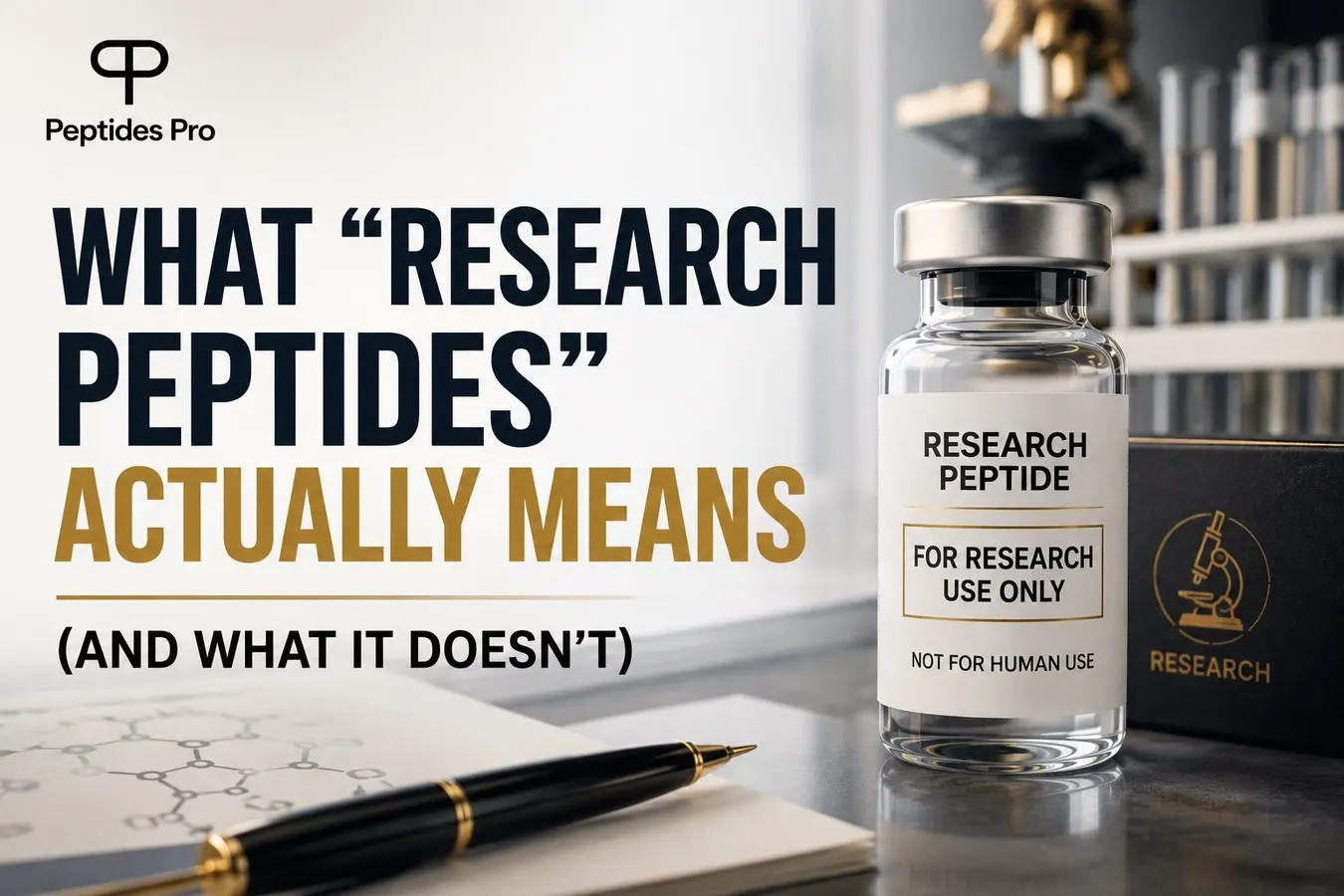
Walk into any corner of the peptide market online and you will see the same phrase repeated on almost every product page, label, and checkout screen: for research use only. It is printed on vials, written in footers, and cited in disclaimers.
Most people read past it. Some assume it is just legal boilerplate, like the "not responsible for lost items" sign in a car park. Others take it at face value and genuinely believe they have purchased a laboratory reagent.
Neither interpretation is quite right. The "research use only" designation is a real regulatory concept with specific legal meaning, specific limitations, and specific implications for anyone using these compounds. Understanding it properly changes how you should think about every peptide purchase.
Where the Label Comes From
The "research use only" classification, often abbreviated RUO, originated in the world of laboratory diagnostics and analytical chemistry. The FDA first defined it in the context of in vitro diagnostic products: devices and reagents sold specifically for use in laboratory research prior to clinical adoption. The category was created to allow scientific investigation to proceed without requiring the full approval process that applies to marketed medical products.
The key phrase in the original regulatory framework is "for investigational purposes and not intended for human use." That framing matters. RUO products are products that have not completed the regulatory pathway required for human use and are therefore legally restricted to controlled research settings: labs, academic institutions, preclinical studies, and similar environments.
When that designation migrated to the peptide market, it carried the same formal meaning but entered a context where it is applied much more loosely.
What the Label Actually Designates
A peptide labeled "research use only" is communicating several things simultaneously.
First, it has not been reviewed by the FDA for safety and efficacy in humans. This is not a minor caveat. The FDA drug approval process exists precisely because compounds that look promising in early research do not always behave predictably in humans across a broader population. Skipping that process means the systematic safety data that would ordinarily be required before widespread human use does not exist.
Second, the compound has not been manufactured to pharmaceutical grade standards. This is perhaps the most practically important point, and the one least discussed in peptide communities.
Pharmaceutical grade manufacturing requires validated processes, rigorous quality controls, third-party testing at multiple stages, and regulatory inspections. Research grade manufacturing does not carry the same requirements. The result is that two vials of BPC-157 labeled "research use only" from two different vendors can contain meaningfully different amounts of active compound, different levels of impurities, different levels of microbial contamination, and different types of residual solvents from synthesis.
Third, the label explicitly disclaims any guidance on human dosing, administration, or intended use. A peptide seller operating under RUO designation is legally prohibited from providing dosing instructions for human use. When vendors include dosing protocols, that is typically done by framing it as "research dosing information" rather than clinical guidance.
What the Label Does Not Mean
This is where the gap between label and reality becomes important.
"Research use only" is not a safety certificate. It does not mean the compound has been tested and found safe. It means it has not been tested in the way required for human use approval. That is a very different statement.
It is also not a quality guarantee. An RUO label tells you nothing about purity, potency, or sterility. A peptide from a supplier with no third-party testing infrastructure and a supplier with rigorous certificate of analysis documentation from an accredited lab both legally qualify for the same "research use only" label.
It does not mean the compound is legal to use in humans in your jurisdiction. The legality of personal use of research peptides varies by country and in some cases by compound. The label does not change the regulatory status of the compound in any given market.
And it does not mean the vendor is conducting or facilitating research. In practice, the overwhelming majority of peptide purchases made under the RUO umbrella are not going into laboratory research. Everyone in the supply chain knows this. The label functions as a legal buffer rather than an accurate description of end use.
The Practical Consequence: Quality Matters More Than Most People Think
Because the RUO designation creates no enforceable quality floor, the range of product quality in the research peptide market is genuinely wide. This is not theoretical hand-wringing.
Analyses of peptide products from online vendors have found issues including peptide content below stated amounts, presence of undisclosed additional compounds, residual solvents from synthesis, and microbial contamination levels that would be unacceptable under pharmaceutical manufacturing standards.
The specific risk depends on the compound, the route of administration, and the vendor. Topical application of a GHK-Cu product with some purity issues is a different risk profile from injecting a GLP-1 peptide with unknown contaminants. The more invasive the administration route, the more the quality gap matters.
This is why certificate of analysis documentation from accredited third-party labs is the single most useful quality signal available to someone sourcing research peptides. A COA does not guarantee safety, but it provides actual data on purity and identity rather than a label that carries no enforceable quality standard.
What It Tells You About a Vendor
The way a vendor handles the RUO framework tells you something about how seriously they take product quality and customer information.
Vendors who use the RUO label as a pure liability shield while providing no supporting quality documentation, offering no guidance on sourcing or testing, and making implicit or explicit human-use claims through their marketing are operating at the low end of the quality spectrum.
Vendors who are transparent about what the label means, provide actual COA documentation, are honest about the limitations of their products, and recommend professional consultation before use are operating differently. The RUO label is the same in both cases. The substance behind it is not.
A Useful Frame
If you encounter a research peptide for the first time, the most honest way to read the "research use only" label is as the following statement: this compound has not been approved for human use, may not have been manufactured to pharmaceutical standards, has not been reviewed for safety or efficacy in humans through the standard regulatory process, and its use in humans is at the user's own risk and discretion.
That framing does not make research peptides dangerous by definition. Some are quite well characterised by accumulated research and clinical observation. But it does clarify what the label actually communicates versus what many buyers assume it means.
Understanding the gap between those two things is the first step in approaching the research peptide space with realistic expectations.
This article is for educational purposes only and does not constitute medical advice. Speak with a qualified healthcare professional before using any peptide, supplement, or health protocol.