
Education
When a Peptide Side Effect Becomes a Medical Emergency
Published Oct 20, 2026
Learn which peptide side effects may require urgent medical attention, from severe allergic reactions and dehydration to abdominal pain, hypoglycaemia and other warning signs.
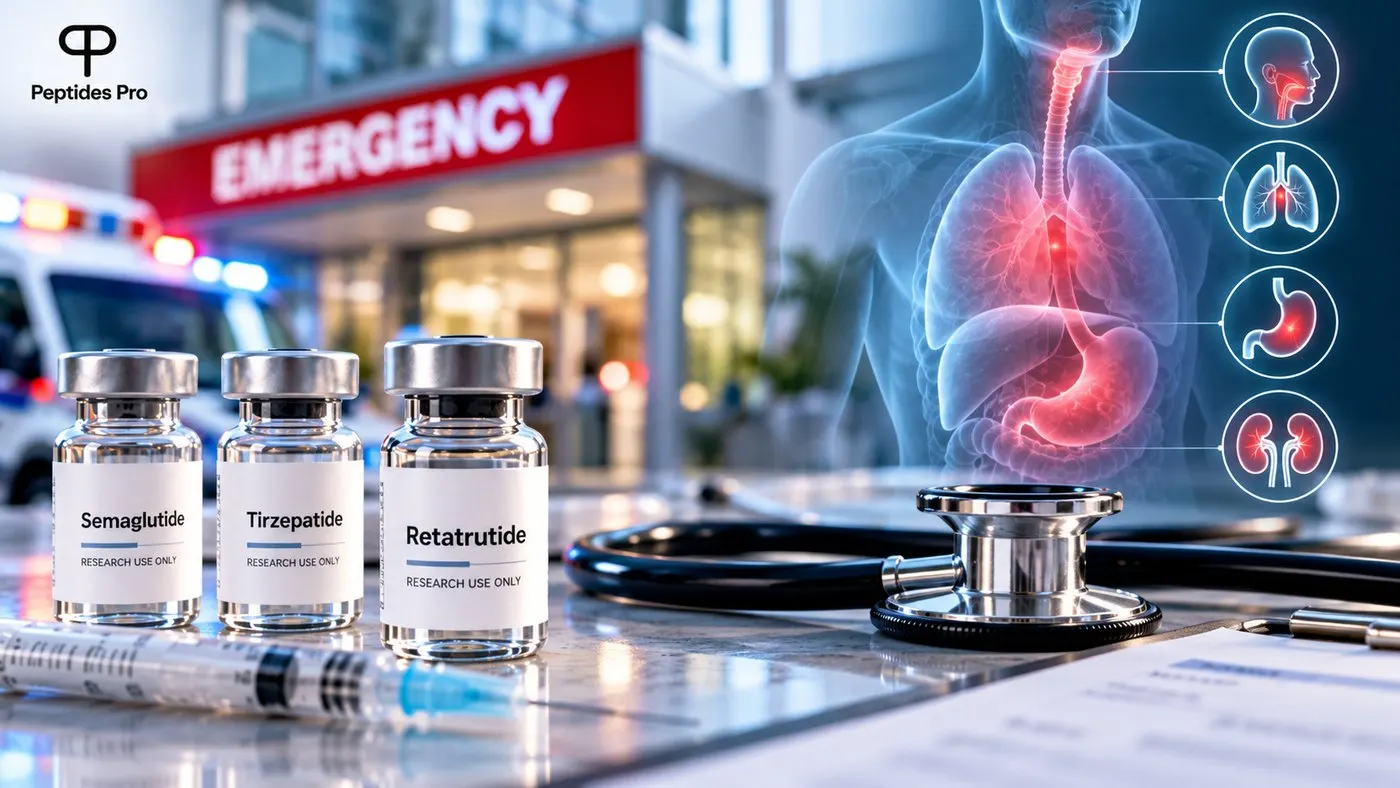
Most side effects do not automatically mean something dangerous is happening.
Nausea, headache, fatigue or minor irritation around an injection site can occur with some peptide based medicines without becoming a medical emergency.
The situation changes when symptoms begin affecting breathing, consciousness, circulation, hydration or major organ function, or when pain becomes severe and persistent.
Difficulty breathing, swelling of the tongue or throat, collapse, seizures, loss of consciousness, severe persistent abdominal pain or repeated vomiting with serious dehydration should not be treated as ordinary side effects.
There is also an important distinction behind the word peptide.
Semaglutide and tirzepatide are extensively studied medicines with approved pharmaceutical products.
Experimental compounds such as BPC-157 and TB-500 do not have comparable human safety data.
That difference matters when deciding how much confidence can be placed in a list of supposedly "normal" side effects.
Emergency symptoms should be assessed based on their severity, not simply on whether they appeared after taking a peptide product.
Seek urgent or emergency medical help if someone develops symptoms such as:
- difficulty breathing or severe wheezing
- swelling of the face, tongue or throat
- collapse or loss of consciousness
- a seizure
- severe confusion or inability to respond normally
- severe chest pain
- sudden stroke like symptoms
- severe or persistent abdominal pain
- repeated vomiting with fainting, confusion or inability to remain hydrated
- severe low blood sugar causing confusion, seizure or unconsciousness
Do not wait for proof that a peptide caused the problem.
If someone is unconscious, struggling to breathe, having a seizure or otherwise appears critically ill, contact local emergency services.
One of the clearest medication emergencies is anaphylaxis.
Anaphylaxis is a severe allergic reaction that can develop rapidly and become life threatening.
Warning signs can include difficulty breathing, wheezing, swelling of the lips, tongue or throat, dizziness, fainting and loss of consciousness.
Read the MedlinePlus guidance on anaphylaxis
Serious hypersensitivity reactions have also been reported with some peptide based medicines.
The current prescribing information for Wegovy, which contains semaglutide, states that serious hypersensitivity reactions including anaphylaxis and angioedema have been reported.
Read the current Wegovy prescribing information on DailyMed
A small patch of redness around an injection site is very different from throat swelling, breathing difficulty or collapse.
Once breathing or circulation is affected, the situation should be treated as an emergency.
Nausea, vomiting and other gastrointestinal symptoms are well known with GLP-1 medicines such as semaglutide.
That familiarity can create a problem.
A person may assume that severe abdominal symptoms are simply part of taking the medicine.
The current Wegovy prescribing information warns about acute pancreatitis.
Symptoms can include persistent or severe abdominal pain, sometimes radiating into the back, with or without nausea or vomiting.
Read the Wegovy safety information on DailyMed
Gallbladder disease is another recognised risk.
This does not mean that every episode of stomach pain is pancreatitis or gallbladder disease.
It means that severe or persistent abdominal pain should not automatically be normalised because gastrointestinal side effects are common.
Vomiting may begin as a medication side effect but become clinically important if it continues.
The major concern is dehydration.
The current Wegovy prescribing information warns about acute kidney injury associated with volume depletion. Many reported cases followed gastrointestinal reactions such as nausea, vomiting or diarrhoea that caused dehydration.
Warning signs that deserve prompt medical assessment include:
- inability to keep fluids down
- fainting
- severe weakness
- confusion
- very little urine
- symptoms that continue to worsen
FDA has also received reports of people requiring medical attention or hospitalisation following dosing errors with compounded injectable semaglutide.
Reported problems included severe nausea, vomiting, abdominal pain, fainting, dehydration, acute pancreatitis and gallstones.
Read the FDA alert on compounded semaglutide dosing errors
Some peptide based medicines affect blood glucose.
Semaglutide can increase the risk of hypoglycaemia when used with insulin or medicines that stimulate insulin secretion.
Mild low blood sugar may cause symptoms such as sweating, shaking, hunger, dizziness or palpitations.
Severe hypoglycaemia is different.
Confusion, abnormal behaviour, inability to respond normally, seizures or unconsciousness can indicate a medical emergency.
The risk depends heavily on the specific medicine and other diabetes treatments being used.
It should not be generalised to every peptide.
One of the biggest mistakes is assuming that a common side effect must also be harmless.
A symptom can move along a spectrum.
For example:
nausea can progress to repeated vomiting
repeated vomiting can cause dehydration
severe dehydration can affect blood pressure and kidney function
The important questions are therefore not simply:
"Is nausea a known side effect?"
or:
"Can this medicine cause vomiting?"
The more useful questions are:
How severe is it?
Is it getting worse?
Can the person remain hydrated?
Are they fainting, confused or becoming difficult to wake?
Are there signs that another organ may be involved?
The situation becomes more difficult with experimental compounds.
For established medicines, clinical trials and postmarketing surveillance provide information about recognised adverse reactions.
For experimental peptides, the human evidence may be much thinner.
FDA states that it has limited safety information for BPC-157 and lacks sufficient information to know whether compounded BPC-157 could cause harm through proposed routes of administration.
FDA also states that it has not identified human exposure data for the thymosin beta-4 fragment known as TB-500.
Read FDA's information on bulk substances with potential safety risks
This creates an important problem.
A lack of well documented adverse effects does not necessarily mean an experimental peptide is safe.
It may mean that the substance has not been studied in enough people to define its risks reliably.
That is why confident online lists of "normal BPC-157 side effects" or "expected TB-500 reactions" should be approached cautiously.
Not every reaction after a peptide product necessarily comes from the intended active ingredient.
With compounded, unapproved or research labelled products, additional possibilities can include:
- incorrect concentration
- dosing errors
- contamination
- impurities
- another active ingredient
- incorrect product identity
- improper storage
FDA has warned that compounded drugs do not undergo the same premarket review for safety, effectiveness and quality as FDA approved drugs.
Read FDA's explanation of compounded drug risks
This makes the product itself important when a serious reaction is being assessed.
Some experimental peptide products are sold with phrases such as "research use only" or "not for human consumption."
Those labels do not establish that the product is safe.
FDA has warned about unapproved products containing semaglutide, tirzepatide and retatrutide that were labelled for research while being sold directly to consumers for human use.
Read FDA's guidance on unapproved GLP-1 products
The same basic principle applies more broadly.
A research label does not provide human safety evidence.
Laboratory testing can be useful.
Depending on what was tested, a certificate of analysis may provide information about identity, purity or other analytical characteristics.
But it does not establish:
- clinical effectiveness
- long term human safety
- appropriate use for a particular patient
- the absence of every possible contaminant
- that every vial sold under the same brand matches the sample tested
A laboratory report and a clinical safety profile are different things.
Another important distinction is causation.
If someone becomes unwell after using a peptide product, timing may raise suspicion.
But that does not prove the peptide caused the event.
Other possible explanations can include:
- another medicine
- an underlying illness
- infection
- dehydration
- a dosing error
- contamination
- an incorrectly labelled product
- an unrelated medical event
This is one reason serious symptoms should be medically assessed rather than diagnosed through online discussions.
If someone becomes unwell after taking a peptide based medicine or experimental product, useful information for healthcare professionals can include:
- the exact product name
- the active ingredient listed on the label
- whether it was a prescription medicine, compounded preparation or research labelled product
- when the product was taken
- when symptoms began
- other medicines or supplements being used
- relevant medical conditions
- the packaging or product label, if available
This information can help clinicians consider medication reactions, dosing errors, interactions, contamination and unrelated medical conditions.
In the United States, patients and healthcare professionals can report suspected adverse reactions or product quality problems involving FDA regulated medical products through MedWatch.
Read FDA's MedWatch reporting guidance
Reporting an adverse event is not the same thing as obtaining emergency treatment.
If someone is critically ill, emergency medical care comes first.
Is Nausea From a Peptide a Medical Emergency?
Usually not by itself.
It becomes more concerning when it is severe or persistent, when repeated vomiting prevents adequate fluid intake, or when it occurs with severe abdominal pain, fainting, confusion or signs of significant dehydration.
Is Severe Abdominal Pain From Semaglutide Normal?
It should not automatically be dismissed as normal.
Semaglutide prescribing information includes warnings concerning acute pancreatitis and gallbladder disease.
Persistent or severe abdominal pain needs medical assessment.
When Is an Allergic Reaction an Emergency?
Breathing difficulty, throat swelling, tongue swelling, collapse, severe dizziness or loss of consciousness can indicate a serious allergic reaction and require immediate medical attention.
Can Peptide Medicines Affect the Kidneys?
Some can contribute indirectly to kidney problems.
For semaglutide, FDA approved prescribing information warns about acute kidney injury related to volume depletion, particularly following gastrointestinal symptoms that cause dehydration.
That does not mean all peptides have the same kidney risk.
Can Low Blood Sugar Become Dangerous?
Yes, with certain glucose lowering medicines and combinations.
Severe hypoglycaemia can affect brain function and may cause confusion, seizures or unconsciousness.
Does BPC-157 Have an Established List of Human Side Effects?
No dependable comprehensive list exists.
FDA states that human safety information for BPC-157 remains limited.
Much of the published literature is preclinical, so it is difficult to estimate how often specific adverse effects occur in humans.
The most useful question is not simply:
"Is this a known peptide side effect?"
It is:
"Is this symptom severe, worsening or threatening breathing, consciousness, circulation, hydration or major organ function?"
Mild nausea, temporary headache or minor local irritation may occur with some medicines without becoming emergencies.
Breathing difficulty, facial or throat swelling, collapse, seizures, severe persistent abdominal pain, profound dehydration, serious hypoglycaemia or loss of consciousness are different.
Those symptoms require urgent medical assessment regardless of whether the suspected cause is a peptide.
And with experimental compounds such as BPC-157 or TB-500, there is an additional problem.
Human safety evidence is too limited to define a dependable catalogue of normal reactions.
When symptoms are severe, unfamiliar or rapidly worsening, they should not be normalised simply because the product was marketed as a peptide.
Current prescribing information covering pancreatitis, gallbladder disease, acute kidney injury due to volume depletion, severe gastrointestinal reactions, hypoglycaemia and serious hypersensitivity reactions.
FDA alert describing dosing errors, hospitalisations and reported adverse events involving compounded semaglutide.
Current FDA information concerning unapproved semaglutide, tirzepatide and retatrutide products.
FDA safety information concerning experimental substances including BPC-157, TB-500 and CJC-1295.
FDA explanation of the differences between compounded and FDA approved medicines.
National Library of Medicine information on symptoms and emergency treatment of severe allergic reactions.
Official FDA adverse event and product problem reporting information.
Medical Disclaimer
This article is for educational and informational purposes only. It does not diagnose medical emergencies or provide personalised medical advice.
If someone has difficulty breathing, severe swelling of the face or throat, collapses, loses consciousness, experiences a seizure or otherwise appears critically ill, contact the local emergency service immediately.