
Education
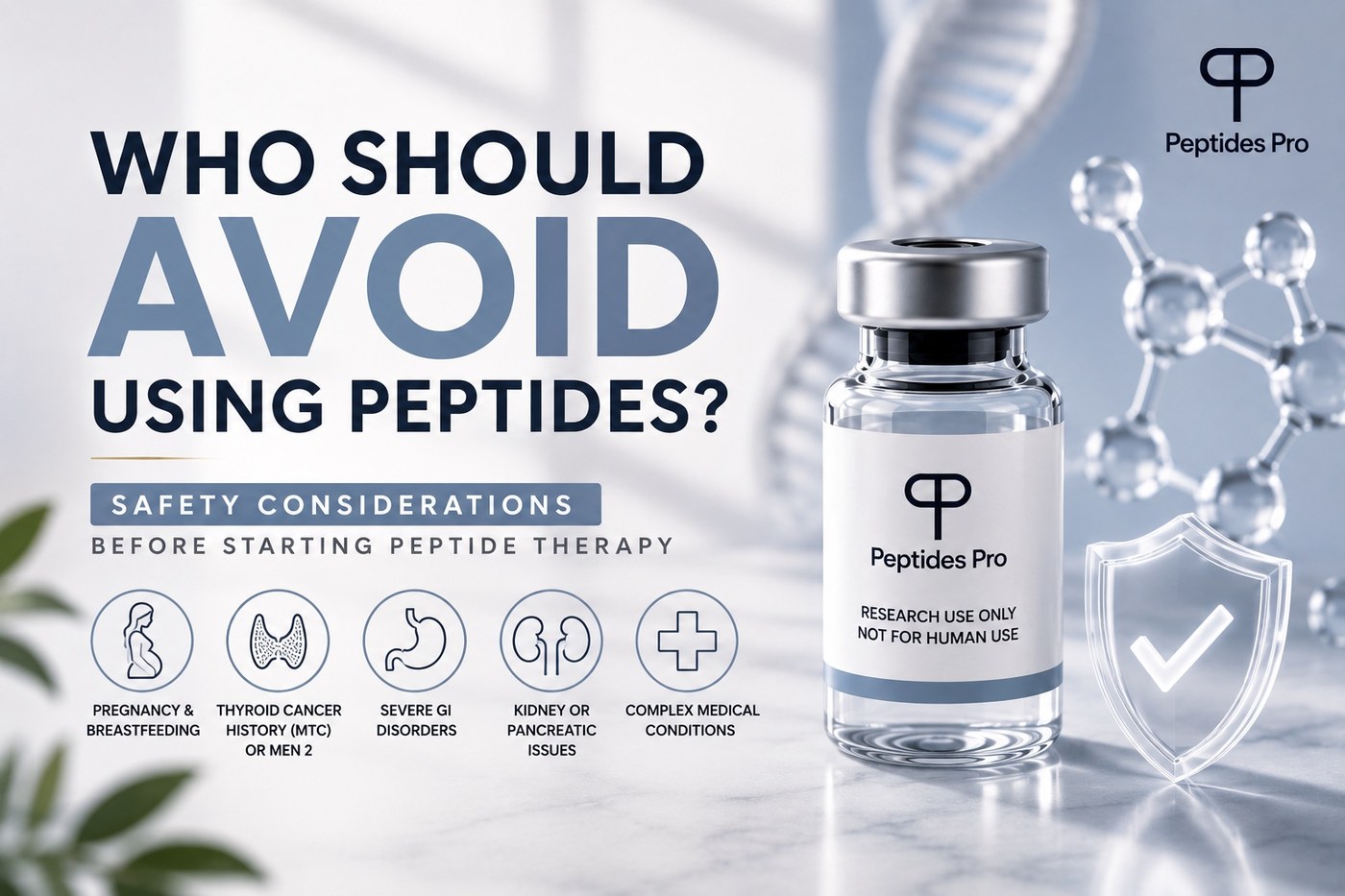
Who Should Avoid Peptides? Safety Considerations Before Starting Peptide Therapy
Published Aug 26, 2026
Peptides are not automatically safe just because they occur naturally in the body. Here is who should avoid certain peptide therapies, which conditions require extra caution, and why approved peptide medicines are different from research peptides.
Peptides have moved from a niche area of medical research into mainstream wellness conversations.
You now see them discussed for weight management, muscle recovery, skin health, longevity, sleep, hormones, injury recovery and athletic performance. Some peptide medicines have transformed modern medicine. Insulin is a peptide. GLP-1 receptor agonists such as semaglutide are peptide-based medicines. Other peptide drugs have been used clinically for decades.
But this creates an important misunderstanding:
"Peptide" does not mean "safe."
A peptide is simply a type of molecule. Different peptides can have completely different biological effects, different clinical evidence, different side-effect profiles and completely different regulatory statuses.
A prescription peptide medicine that has passed large clinical trials is not equivalent to an experimental peptide purchased online with a "research use only" label.
That distinction is one of the most important things to understand before considering peptide therapy.
So, Who Should Avoid Peptides?
There is no single list of people who should avoid every peptide.
Instead, the answer depends on which peptide you are talking about, why you are taking it, your medical history, and how much human safety data actually exists.
Someone using an FDA-approved peptide medicine under medical supervision is in a very different situation from someone injecting an unapproved research peptide obtained from an online supplier.
However, there are several groups of people who should be particularly cautious.
1. People Who Are Pregnant or Trying to Become Pregnant
Pregnancy is one of the clearest situations where experimenting with unapproved peptides is a bad idea.
The developing fetus is extremely sensitive to changes in hormonal and metabolic signaling, and many experimental peptides have never been adequately studied in pregnant humans.
Even approved peptide medicines can have specific pregnancy restrictions.
For example, the prescribing information for semaglutide products warns about potential fetal harm based on animal reproductive studies and recommends stopping semaglutide at least two months before a planned pregnancy.
Tirzepatide also carries pregnancy warnings. Its prescribing information states that weight loss offers no benefit during pregnancy and may cause fetal harm.
That does not mean every peptide molecule is dangerous during pregnancy. It means that pregnancy is not the time to experiment with a compound whose reproductive safety has not been established.
If you are pregnant, planning pregnancy or breastfeeding, peptide therapy should be discussed with your obstetrician or another qualified healthcare professional rather than treated as a wellness experiment.
2. People With a History of Certain Thyroid Cancers
This is particularly important with GLP-1 receptor agonists and related medicines.
Semaglutide and tirzepatide carry a specific contraindication for people with a personal or family history of medullary thyroid carcinoma (MTC) or Multiple Endocrine Neoplasia syndrome type 2 (MEN 2).
This warning exists because these drugs caused thyroid C-cell tumors in animal studies. Whether the same effect occurs in humans remains uncertain, but the regulatory warning is strong enough that these medicines are contraindicated in people with those conditions.
This is an excellent example of why asking "Are peptides safe?" is too broad a question.
The more useful question is:
"Is this particular peptide appropriate for someone with my medical history?"
3. People With Serious Gastrointestinal Problems
Some peptide medicines dramatically affect the digestive system.
GLP-1-based medicines such as semaglutide and tirzepatide slow gastric emptying and can cause nausea, vomiting, diarrhea, constipation and abdominal discomfort.
Tirzepatide's prescribing information specifically states that it has not been studied in people with severe gastrointestinal disease, including severe gastroparesis, and is not recommended for those patients.
Someone who already has significant problems with gastric emptying should therefore not treat a GLP-1 medication like an ordinary weight-loss supplement.
The same principle applies more broadly to experimental peptides: if a compound is known or suspected to affect gastrointestinal motility, appetite, hormones or metabolism, an existing gastrointestinal disorder can materially change the risk.
4. People With a History of Pancreatitis or Significant Pancreatic Problems
Pancreatic health deserves particular attention with GLP-1-based medicines.
Acute pancreatitis has been reported in people treated with GLP-1 receptor agonists and tirzepatide. Current prescribing information tells clinicians to watch for symptoms such as persistent severe abdominal pain, sometimes radiating to the back.
A previous episode of pancreatitis does not automatically mean that every peptide is forbidden.
It does mean that self-experimentation is a poor strategy.
Anyone with a history of pancreatitis should discuss the specific medication and its risks with a healthcare professional before starting treatment.
5. People With Significant Kidney Problems or a High Risk of Dehydration
The issue here is often indirect.
Some peptide medicines can cause substantial nausea, vomiting or diarrhea. Severe gastrointestinal side effects can lead to dehydration, which can then contribute to acute kidney injury.
This becomes particularly important for people who already have impaired kidney function or who are vulnerable to dehydration.
The risk is not necessarily that the peptide is directly toxic to the kidneys.
The problem can be the chain of events:
peptide → gastrointestinal side effects → fluid loss → dehydration → kidney stress
This is one reason seemingly simple side effects should not always be dismissed as harmless.
6. People With Serious Allergies to the Compound or Its Ingredients
Anyone who has previously experienced a serious allergic reaction to a specific peptide medicine or one of its ingredients should not simply try it again.
Serious hypersensitivity reactions, including anaphylaxis and angioedema, have been reported with some approved peptide medicines.
This is another situation where "it's just a peptide" is misleading.
The body can mount serious immune reactions to biologically active molecules.
And with compounded or poorly characterized products, there is an additional question:
Do you actually know everything that is in the vial?
That is why pharmaceutical quality and ingredient transparency matter.
7. People With Active or Complex Medical Conditions Should Not Self-Experiment
This category is broader but extremely important.
If you have significant cardiovascular disease, uncontrolled diabetes, endocrine disorders, serious liver disease, kidney disease, autoimmune disease, a history of cancer, or take multiple prescription medications, adding a biologically active peptide without professional oversight can create unnecessary uncertainty.
This does not mean people with these conditions can never use peptide medicines.
In fact, many peptide medicines are specifically designed to treat serious medical conditions.
Insulin is used to treat diabetes.
Certain peptide hormones are used in endocrine medicine.
GLP-1 receptor agonists are prescribed for diabetes, obesity and cardiovascular risk reduction in appropriate patients.
The difference is medical indication, evidence, monitoring and product quality.
8. Children and Teenagers Should Not Use Experimental Peptides
Children are not simply smaller adults.
Their endocrine systems, metabolism, growth and reproductive development are still changing.
Some peptide medicines are legitimately used in pediatric medicine for specific conditions, but that is completely different from using an experimental peptide for muscle growth, recovery, aesthetics or longevity.
An unapproved peptide marketed online for adults should not automatically be assumed appropriate for a teenager.
If a peptide has a legitimate pediatric indication, it should be used according to established medical guidance.
9. People Taking Multiple Hormone-Active Compounds Need Extra Caution
Some peptides interact with hormonal pathways.
Growth-hormone secretagogues, for example, can affect growth hormone and downstream signaling involving IGF-1.
Combining several hormone-active compounds can make it difficult to determine which substance is responsible for an unwanted effect.
It can also create biological effects that were never studied together in clinical trials.
This is particularly relevant to "stacks" promoted online.
A stack can look sophisticated because it contains several compounds.
Scientifically, however, more compounds can mean more uncertainty.
10. People Buying "Research Peptides" Should Understand What the Label Actually Means
One of the biggest misconceptions in the peptide world is the phrase:
"For research use only."
That phrase does not mean:
"Safe for humans."
It generally means the product is being marketed for laboratory research rather than approved as a medicine for human treatment.
This distinction becomes especially important with compounds such as BPC-157, TB-500, CJC-1295, ipamorelin and other peptides that are widely discussed in wellness and biohacking communities.
Some have interesting biological mechanisms and substantial preclinical research.
That does not automatically mean they have been proven safe and effective in humans.
BPC-157 is a particularly good example.
A recent review found substantial preclinical interest but emphasized that human evidence remains extremely limited and that large, rigorous clinical trials are lacking.
Another recent review described BPC-157 as an investigational peptide with major pharmaceutical-development gaps, including limited pharmacokinetic data, formulation characterization and clinical evidence.
That is a very different evidence level from an approved medicine supported by large randomized clinical trials.
The Difference Between "Approved Peptide" and "Research Peptide"
This distinction deserves its own section because it changes the entire safety conversation.
Approved peptide medicines
These have gone through a formal regulatory process.
Depending on the medicine, that process can include:
- Laboratory research
- Toxicology studies
- Pharmacokinetic studies
- Phase 1 clinical trials
- Phase 2 clinical trials
- Phase 3 clinical trials
- Manufacturing quality controls
- Regulatory review
- Post-marketing safety monitoring
That does not make an approved peptide risk-free.
It means the risks, benefits, dosing and quality have been investigated to a substantially greater degree.
Unapproved research peptides
These may have:
- Animal studies
- Cell studies
- Small human studies
- Case reports
- Mechanistic research
- Limited pharmacokinetic information
- Little or no large-scale clinical trial data
Some may eventually become legitimate medicines.
Others may fail because they are ineffective, unsafe, unstable or impossible to manufacture reliably.
The uncertainty is the key issue.
What About BPC-157?
BPC-157 is one of the most searched and discussed research peptides.
Its popularity comes largely from animal and laboratory research suggesting effects involving tissue repair, inflammation, blood vessels and gastrointestinal biology.
But the human evidence remains far smaller than the internet often makes it sound.
A recent review identified only a small number of human pilot studies and concluded that rigorous, large-scale clinical trials are still lacking.
A 2025 pilot study involving intravenous BPC-157 included only two participants. The study reported that the infusions were tolerated without measurable adverse effects in the tested parameters.
That is interesting.
It is not proof of long-term safety.
Two people cannot establish the safety profile of a peptide for thousands or millions of people.
This is one of the most important concepts in interpreting peptide research:
A positive small study is a signal. It is not the final answer.
What About CJC-1295 and Other Growth-Hormone-Related Peptides?
These peptides deserve particular caution because they deliberately influence hormonal signaling.
CJC-1295 and related compounds are often marketed for muscle growth, recovery, sleep, body composition or longevity.
But increasing a biological signal does not automatically mean the overall result is beneficial.
Bryan Johnson recently described his own experiment with CJC-1295 and made a point that is worth remembering:
> "Peptides can be bad, too."
He reported measuring changes in several metabolic and sleep-related markers and stopped the experiment after only two doses.
His experience is not a clinical trial and should not be interpreted as proof that CJC-1295 is dangerous for everyone.
But it illustrates a useful principle:
A compound can produce its intended biological effect and still produce unwanted effects.
That is something peptide marketing often fails to explain.
Even Famous Peptide Advocates Do Not Prove That Peptides Are Safe
Peptides have become popular partly because high-profile athletes, podcasters, longevity enthusiasts and biohackers talk openly about them.
Joe Rogan, for example, has publicly discussed peptides such as BPC-157 and TB-500 in the context of injury recovery.
That can make these compounds appear more established than they actually are.
But celebrity experience is not the same thing as clinical evidence.
A person can take a peptide, recover from an injury and believe the peptide helped.
That does not establish that the peptide caused the recovery.
This is where scientific evidence matters.
Peter Attia, a physician who recently devoted an extensive episode of his podcast to evaluating peptides, summarized the broader issue particularly well:
> "The legitimacy is confined to a relatively narrow subset of them."
His approach is useful because it avoids both extremes.
Peptides are not all scams.
Peptides are also not all breakthrough therapies.
The correct answer depends on the individual molecule.
A Better Way to Think About Peptide Safety
Instead of asking:
"Are peptides safe?"
Ask these seven questions:
1. What exactly is the peptide?
Know the precise compound.
"Peptide" is not a sufficient answer.
2. Is it approved for human use?
If yes, by which regulator and for which indication?
3. What human clinical evidence exists?
Animal studies are useful, but they cannot substitute for human trials.
4. What are the known contraindications?
Check the actual prescribing information where an approved product exists.
5. What medical conditions could change the risk?
Pregnancy, endocrine disorders, gastrointestinal disease, kidney disease, allergies and previous serious adverse reactions may all matter depending on the peptide.
6. What else are you taking?
Drug interactions and combinations can change the risk profile.
7. Where did the product come from?
A scientifically interesting peptide becomes a very different proposition when the product's identity, sterility, concentration or purity cannot be verified.
The Product Matters as Much as the Molecule
This is one of the least discussed parts of peptide safety.
Two vials can carry the same name while representing very different levels of confidence.
One might be an approved pharmaceutical product manufactured under tightly controlled standards.
Another might be a compounded preparation.
Another might be an online "research" vial with uncertain manufacturing controls.
The molecule's theoretical mechanism does not tell you whether the vial is sterile, correctly labelled or accurately dosed.
The FDA has repeatedly warned about risks associated with unapproved compounded GLP-1 products, including dosing errors, quality concerns and adverse events.
The agency has also warned that compounded drugs do not undergo the same premarket review for safety, effectiveness and quality as FDA-approved medicines.
That distinction should be part of every peptide safety conversation.
So Which Peptides Are Actually "Okay"?
This is where the answer needs to be precise.
There is no scientifically responsible list saying:
"These peptides are safe for everyone."
There are, however, peptide medicines with established medical uses and regulatory approval.
Examples include:
- Insulin
- Semaglutide
- Tirzepatide
- Desmopressin
- Oxytocin
- Certain peptide-based hormone therapies
- Other peptide medicines approved for specific diseases and conditions
But even these are not universally appropriate.
Semaglutide can be highly appropriate for one patient and inappropriate for another.
Tirzepatide can be an effective prescription medicine while still being contraindicated in people with certain thyroid cancer histories or serious hypersensitivity to the drug.
The correct question is therefore not:
"Which peptide is safe?"
It is:
"Which peptide has an appropriate indication, evidence base and safety profile for this particular person?"
That is a much more useful question.
The Biggest Red Flag: When Marketing Is Stronger Than the Evidence
Be cautious when a peptide website promises that one compound will simultaneously:
- Build muscle
- Burn fat
- Repair tendons
- Reverse aging
- Improve sleep
- Increase testosterone
- Regenerate organs
- Improve cognition
- Extend lifespan
Biology rarely works that neatly.
A legitimate therapeutic effect is usually much more specific.
The strongest peptide medicines have specific mechanisms, specific indications, specific clinical evidence and specific risks.
The further a marketing claim moves away from what has actually been studied in humans, the more skeptical you should become.
What Scientists Actually Want to Know
Before a new peptide becomes a serious medicine, researchers need answers to questions that marketing pages rarely discuss.
How does the compound behave in the body?
How long does it remain active?
What receptors does it interact with?
What happens at different exposure levels?
What happens after repeated exposure?
What happens in people with kidney or liver impairment?
Does the immune system react to it?
Does it interact with other medicines?
Does it affect fertility or pregnancy?
Does it produce unexpected effects after months or years?
Is the manufacturing process reproducible?
Can the final product be made sterile and consistently?
These questions are why drug development takes years.
The Bottom Line
Peptides are neither automatically dangerous nor automatically safe.
They are a huge category of biologically active molecules with radically different levels of evidence.
Some peptide medicines are among the most important therapies in modern medicine.
Others remain experimental.
Some have promising animal research but almost no meaningful human data.
And some products sold online may have uncertainties that have nothing to do with the peptide's mechanism at all.
People who are pregnant, have serious medical conditions, take multiple medications, have relevant allergies, or are considering hormone-active or experimental peptides should be especially cautious.
The safest approach is not to fear every peptide.
It is to stop treating "peptide" as a synonym for "safe."
Look at the specific molecule.
Look at the human evidence.
Look at the regulatory status.
Look at the patient's medical history.
And most importantly, separate a promising scientific idea from a proven medical treatment.
This article is for educational and informational purposes only. It does not constitute medical advice, diagnosis, or treatment. Peptides vary substantially in their regulatory status, evidence, indications and safety profiles. Prescription peptide medicines should be used only under appropriate medical supervision. Unapproved or research-use-only peptides may not have established safety, efficacy, purity or dosing standards. Anyone who is pregnant, planning pregnancy, breastfeeding, has a significant medical condition, takes prescription medications, or has a history of serious drug reactions should consult a qualified healthcare professional before considering peptide therapy.