
Peptide Science
Why Do Peptides Work in Animals but Fail in Humans?
Published Aug 23, 2026
Animal studies can show that a peptide has biological activity, but they cannot guarantee that it will work safely in people. Here is why peptide research can look promising in animals and still fail during human clinical trials.
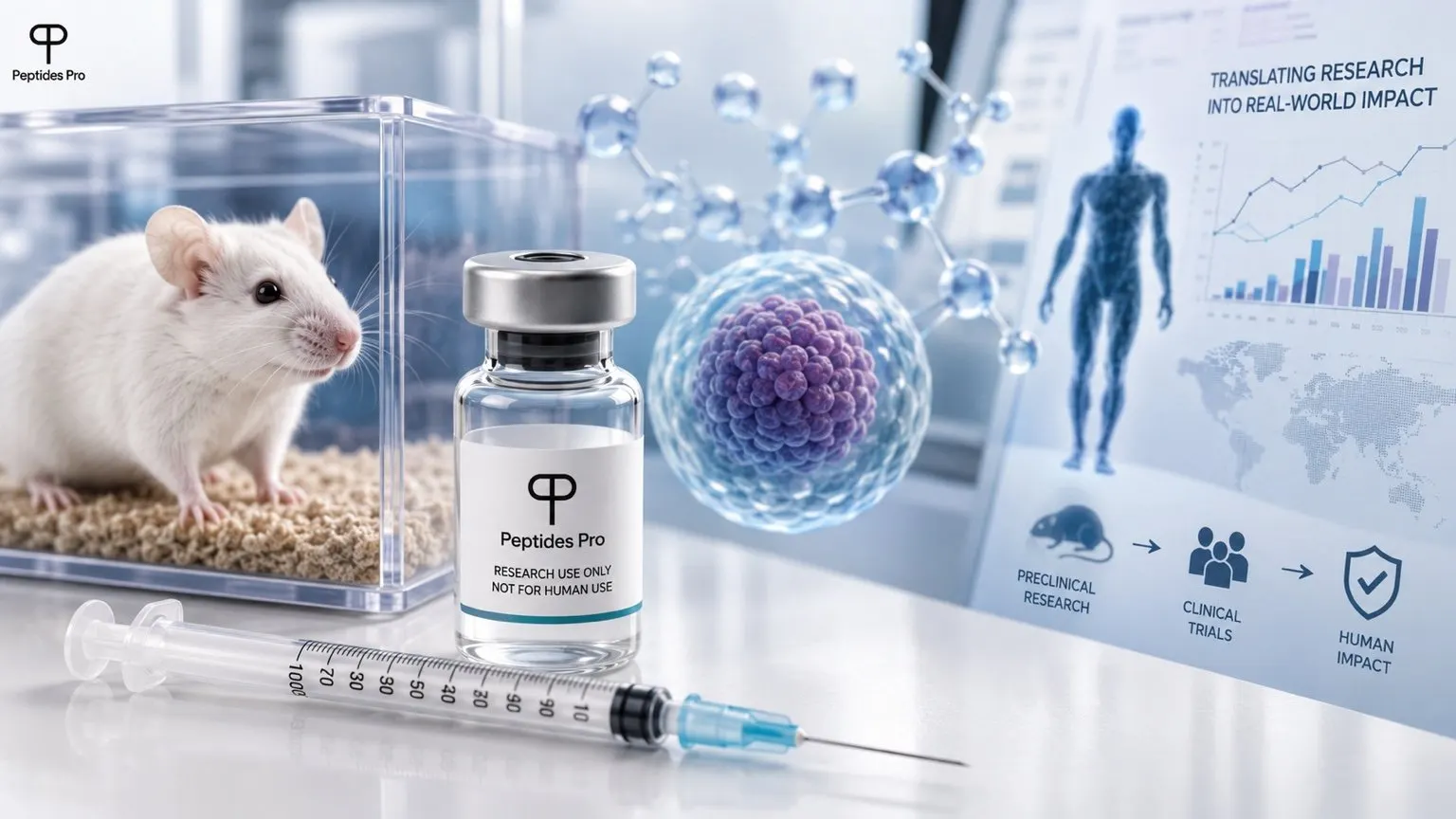
A peptide can look extremely promising in a laboratory.
Researchers may discover that it binds to its intended target. Cells may respond to it. A disease model in an animal may improve after treatment. Blood markers may move in the expected direction. The results can be strong enough to justify taking the candidate into further development.
And then something unexpected happens.
The peptide enters human clinical trials and the results are weaker than expected. Sometimes the benefit is much smaller. Sometimes there is no meaningful benefit at all. In other cases, an unexpected safety problem appears.
This is one of the biggest questions in modern drug development:
If a treatment works in an animal, why doesn't that automatically mean it will work in humans?
The answer is not simply that "animals are different from humans." The problem is much more complicated.
Animal studies are designed to answer important questions about a potential medicine before it is given to people. But every model has limitations. Researchers therefore increasingly combine animal research with human cells, organoids, organ-on-chip systems, computational models and other human-relevant approaches.
For peptide drugs, this distinction is especially important because their activity depends on molecular targets, pharmacokinetics, stability, tissue distribution and biological context.
What Scientists Actually Learn From Animal Studies
It is easy to misunderstand what an animal study is supposed to prove.
An animal experiment does not prove that a peptide will work in humans.
Instead, it can provide evidence about questions such as:
- Does the peptide reach the relevant tissues?
- Does it interact with the intended biological target?
- What happens to the peptide after administration?
- How quickly is it absorbed?
- How long does it remain in circulation?
- How is it metabolized?
- How is it eliminated?
- Are there signs of toxicity?
- Does the biological mechanism appear to produce the expected effect?
These questions are part of the broader preclinical stage of drug development.
For peptide therapeutics, researchers are particularly interested in properties such as stability, specificity and pharmacokinetics because these can strongly influence whether a promising molecule can eventually become a useful medicine.
An animal study therefore provides evidence.
It does not provide a guarantee.
Why Scientists Use Animals in the First Place
One major reason is that some questions cannot be answered adequately using isolated cells.
Imagine researchers discover a peptide that activates a particular receptor.
A cell-based experiment might demonstrate that the receptor responds to the peptide. That is valuable information.
But the human body is not simply a collection of cells in a laboratory dish.
Once a peptide enters an organism, many additional factors become important.
The peptide may be broken down by enzymes. It may be distributed differently between tissues. It may bind to proteins in the bloodstream. It may be cleared through the kidneys or other pathways. Its concentration may change over time.
A whole organism therefore provides information that a simple cell experiment cannot fully reproduce.
Historically, animal models have played an important role in understanding disease biology, pharmacology and potential toxicity before human testing.
But that does not mean animals are perfect models of humans.
They are not.
The First Problem: Biology Is Not Identical Between Species
One of the most obvious differences is also one of the most important.
A mouse is not a small human.
A peptide can interact with the same general biological pathway in two species while producing different outcomes because the underlying biology is not identical.
Receptors can differ.
Enzymes can differ.
Metabolism can differ.
Immune responses can differ.
The distribution of a target throughout the body can differ.
Even when a target exists in both species, its expression level, location or biological importance may not be identical.
This creates a fundamental challenge for researchers:
How closely does the animal model reproduce the biology that actually matters in humans?
The answer depends heavily on the peptide, the target and the disease being studied.
The Second Problem: The Animal Disease Model May Not Fully Represent Human Disease
This is one of the most important concepts in translational research.
Researchers often need to create an experimental model that reproduces certain features of a human disease.
But reproducing a disease is not the same as reproducing the entire human condition.
Human diseases can involve genetics, age, environment, lifestyle, immune function, metabolism and interactions between multiple biological systems.
An experimental animal model may reproduce one or several important features while missing others.
That means a peptide can appear effective because it successfully changes the specific feature being measured in the model.
When the same biological intervention reaches humans, the overall disease may be more complicated.
This is one reason researchers increasingly question whether a particular animal model is sufficiently predictive for the question being asked.
The Third Problem: Dose and Exposure Are Not Simple Comparisons
Another common misunderstanding is comparing an animal dose directly with a human dose.
A dose that produces an effect in a mouse cannot simply be converted into a human dose by dividing the animal's weight.
Researchers instead have to consider pharmacokinetics and pharmacodynamics.
Pharmacokinetics asks what the body does to the peptide.
Pharmacodynamics asks what the peptide does to the body.
Scientists examine factors such as:
- Blood concentration
- Exposure over time
- Absorption
- Distribution
- Metabolism
- Elimination
- Target engagement
- Biological response
Two species can receive what appears to be a similar amount of a peptide but experience very different exposure levels.
This matters because biological activity is related to the concentration reaching the relevant target, not simply the amount administered.
The Fourth Problem: Peptides Can Behave Differently in Different Bodies
Peptides are biologically active molecules, and their behavior can depend heavily on their structure.
Enzymatic degradation can differ between species.
Clearance rates can differ.
Protein binding can differ.
Tissue penetration can differ.
The stability of a peptide in circulation can also influence how long it remains available to interact with its target.
This is one reason peptide drug development often involves extensive work on formulation, stability and pharmacokinetics before a candidate reaches human trials.
A peptide that remains available long enough to produce an effect in one animal species may behave differently in humans.
The Fifth Problem: Animal Studies Can Be Designed Poorly
The limitations of animal research are not always caused by biology.
Study design matters too.
A poorly designed experiment can produce results that look impressive but are difficult to reproduce or translate.
Important features of rigorous preclinical research include appropriate sample sizes, randomization, blinding where appropriate, predefined outcomes and transparent reporting.
If these elements are weak, researchers may overestimate how convincing the findings really are.
This is why modern drug development increasingly emphasizes not just whether an animal study produced a positive result, but how reliable and reproducible that result is.
A positive experiment is not automatically strong evidence.
The Sixth Problem: Human Clinical Trials Test Something Animals Cannot
Once a peptide reaches humans, researchers are no longer asking only whether the molecule can produce a biological effect.
They are asking whether it produces a meaningful benefit in actual patients.
That is a much higher standard.
Human trials introduce factors that animal experiments cannot fully reproduce:
- Genetic diversity
- Different ages
- Different body compositions
- Existing medical conditions
- Other medications
- Different diets and lifestyles
- Differences in disease severity
- Differences in treatment adherence
- Psychological and behavioral factors
A peptide might produce a clear biological signal in a controlled animal model but produce a smaller clinical effect across a diverse human population.
That does not necessarily mean the original animal experiment was useless.
It means the animal model answered a narrower question.
Does an Animal Study Ever Successfully Predict Human Results?
Absolutely.
The point is not that animal research is useless.
Animal studies can provide important information about pharmacology, toxicity and biological mechanisms, and they remain part of many drug-development programs.
The problem is assuming that animal results have perfect predictive power.
The predictive value of an animal model depends on the question being asked and how closely the model represents the relevant human biology.
This is why researchers talk about translation.
Translation is the process of moving evidence from laboratory and preclinical research into useful human treatments.
A successful translation occurs when findings from earlier research meaningfully inform what happens in humans.
A failed translation occurs when promising preclinical evidence does not produce the expected result in clinical development.
This Is Why Human Clinical Trials Matter
The ultimate test of a therapeutic peptide is not a mouse study.
It is evidence from appropriately designed human clinical research.
Clinical development typically progresses through different phases that answer increasingly specific questions about safety, pharmacology, efficacy and longer-term outcomes.
Early human studies may focus heavily on safety and how the body responds to the compound.
Later studies can examine whether the treatment actually produces meaningful clinical benefits in the intended patient population.
This distinction is crucial.
A peptide can have:
Biological activity without proven clinical benefit.
It can also have:
Promising preclinical evidence without sufficient evidence for routine human use.
These are not the same thing as an established therapy.
What About Human Cells and Organoids?
This is where peptide research is becoming particularly interesting.
Scientists are developing methods designed to make preclinical research more human-relevant.
These approaches are often grouped under the term New Approach Methodologies, or NAMs.
Examples include:
- Human cell-based assays
- Three-dimensional cell models
- Organoids
- Spheroids
- Organ-on-chip systems
- Computational models
- In-silico simulations
- Other human-relevant experimental systems
Organoids can reproduce certain aspects of human tissue organization.
Organ-on-chip systems can model interactions between tissues and biological environments.
Computer models can help researchers predict molecular interactions and biological behavior.
These approaches do not automatically replace every animal study.
Their usefulness depends on the specific scientific question and whether the method has been sufficiently validated.
But the direction of research is clear: scientists want models that provide increasingly relevant information about what will happen in humans.
Is Animal Testing Being Replaced?
The scientific landscape is changing.
The FDA has been actively developing a framework for using validated New Approach Methodologies in drug development and has stated that it wants to reduce reliance on animal testing where scientifically appropriate.
Its 2026 guidance discusses approaches including in-vitro models, organoids, spheroids, organs-on-chips and computational methods.
The important word is validated.
A new laboratory technology does not automatically become a reliable replacement simply because it is more modern.
Researchers need evidence that the method is reproducible, scientifically sound and appropriate for the specific question it is being used to answer.
The future is therefore unlikely to be as simple as "animals versus technology."
It is more likely to involve multiple sources of evidence working together.
What This Means for Peptide Research
This matters because the peptide industry often takes a single positive result and turns it into a much bigger claim.
You might see a peptide described online as "proven" because:
- It produced an effect in cells.
- It improved a marker in an animal.
- It increased a biological signal.
- A small study produced an interesting result.
- A mechanism appears scientifically plausible.
None of those statements alone establishes that a peptide is an effective human therapy.
The strength of the evidence depends on the entire chain.
A useful way to think about peptide research is:
Laboratory evidence → Preclinical evidence → Human safety data → Human efficacy data → Clinical evidence
Each stage answers different questions.
The further a peptide progresses through this chain, the more directly the evidence relates to actual human treatment.
Why Social Media Often Gets This Wrong
A common pattern online is:
"This peptide worked in mice."
Then:
"This peptide works."
That second statement is not justified by the first.
A mouse study can be scientifically interesting without establishing clinical effectiveness.
The same problem occurs when people cite a cell study as evidence that a peptide produces a specific benefit in humans.
Cells do not have the complexity of an entire organism, and animals do not perfectly reproduce human biology.
Good science requires keeping those evidence levels separate.
The Better Question to Ask
Instead of asking:
"Does this peptide work?"
A better scientific question is:
"What evidence do we have, and how directly does that evidence answer the question we care about?"
For example:
A receptor assay can tell researchers whether a peptide interacts with a target.
An animal study can provide information about biological activity, pharmacology and potential toxicity.
A pharmacokinetic study can show how the compound behaves in the body.
A clinical trial can provide evidence about safety and efficacy in humans.
Each piece contributes something different.
No single experiment answers everything.
The Bottom Line
Scientists do use animals in peptide and drug research, but animal testing is only one component of the evidence used to develop a medicine.
A peptide can produce impressive results in animals and still fail in humans because species biology, disease models, metabolism, exposure, target engagement, study design and human variability can all affect translation.
That is why modern peptide research increasingly combines multiple approaches, including laboratory experiments, animal studies, human-relevant models and clinical trials.
The most important distinction is simple:
A peptide that works in an animal is a research finding. A peptide demonstrated to be safe and effective in well designed human clinical trials is a very different level of evidence.
Understanding that difference is one of the most important ways to separate genuine peptide science from exaggerated claims online.
Frequently Asked Questions
Do scientists still use animals to test peptides?
Yes. Animal studies remain part of many preclinical drug development programs, although regulators and researchers are increasingly working to reduce or replace animal testing where validated alternatives can provide relevant information.
Does a peptide working in mice mean it will work in humans?
No. Animal results can provide important evidence, but they do not guarantee human efficacy or safety.
Why can't scientists test everything on human cells?
Human cells can answer many important questions, but isolated cells cannot reproduce every aspect of a living organism. Scientists therefore use different models depending on the biological question.
What are organoids?
Organoids are three-dimensional laboratory-grown models derived from cells that can reproduce some characteristics of human tissues or organs. They are increasingly being studied as human-relevant tools in biomedical research.
What are organ-on-chip models?
Organ-on-chip systems use engineered platforms to reproduce selected aspects of tissue or organ function. They can help researchers study biological responses in controlled environments that are designed to be more human-relevant.
What is translational research?
Translational research is the process of moving scientific discoveries from laboratory and preclinical research toward applications in human health. In drug development, an important goal is determining whether findings from laboratory models successfully predict what happens in people.
What is the strongest evidence that a peptide works?
For a therapeutic claim in humans, appropriately designed and conducted human clinical trials provide much more direct evidence than cell experiments or animal studies. The strength of the conclusion also depends on the quality, size, design and results of the clinical evidence.
This article is for educational and informational purposes only. It does not constitute medical advice, diagnosis, or treatment. A peptide showing biological activity in laboratory or animal research does not establish that it is safe or effective for use in humans. Always evaluate peptide claims according to the quality and level of human evidence available.